

A Year’s Review of Non-Fiction
It has been a year.
Responsibility and fatigue have ferociously trespassed on my time, ability, and desire to write anything short of one-sentence sum-ups of my days. Much has transpired.
Well, actually, not much at all. I’m once again fully employed while still maintaining a little side hustle writing and editing various things. I cannot tell a soul where the last eight or so months have sped off to either. They came, and they went. A blazing Georgia summer didn’t scorch nearly as long as I remember previous summers have, even though it did burn from May until the end of September. I’m not really irritated that those scorching summer months went by so quickly, that is, until I try to remember what became of them and can’t fully recall. It feels like it was all last week.

I like what I do now. It’s primarily spreadsheets and data management, which, on its face, isn’t super exciting, but it’s nice having cordial colleagues, reasonable and friendly superiors, and, perhaps most importantly, job security…at least for now. I love it, considering I was on the brink month after month when a project would wrap up, and my applications for job listings were ignored elsewhere. Being able to replenish a bank account with a routine paycheck certainly hasn’t hurt either.
But along the tracks of making new friends, having new professional experiences, and getting to know a whole industry I knew little about, something else picked up steam. I’ve been on the record saying that I discovered early in my seemingly stagnant job search that time could pass as quickly in mediocrity as it could in resplendent delight. I wouldn’t go so far as to say that I’m inundated with happiness (those writing positions I had so much hope for didn’t, after all, pan out), but everything has gotten blurrier with speed; I seem to be scrolling on the phone faster through meaningless content; I’m waiting for the next event to get excited about or the next headline to provoke certain emotions intentionally. And I’m tired all the time. My friends and I discuss our fatigue constantly over tea. My siblings and I disassociate easier and out of nowhere. I’m here, having many of the things I’ve hoped and prayed for, wondering: what’s going on?
I don’t have an answer. It’s what I’ve been concerned with for months now, actively seeking something that can serve as brakes to slow life down, a phenomenon that I’m frankly unaccustomed to feeling with such force. I believe those older than I will throw me the catch-all “it just comes with age,” but even that has begun to ring hollow. Many of those older, wiser folks have noticed a shift in how time seems to be moving more swiftly as well.
It’s echoed a lot in my daily activities. I began by saying how much writing time I’ve missed, and I say it’s due to responsibility and this overwhelming fatigue, but what was I doing when I could have been writing? This job indeed requires much more cognitive puzzle-solving and maze-navigating, and one should always seek time to rest and recover. But what do you do when your mind has been working rapidly for eight hours a day and then gets the opportunity to chill out? It doesn’t seem to want to do anything save for the most pressing engagements (adding a new level of anxiety), whether attending a concert you said you’d have the energy for on a random Tuesday night or swapping the car battery that desperately needs replacing.

Everything has suddenly become more passive. I hate that this is true for me, but something changed along the way. I can count on two hands the number of times I’ve fully participated in my life in the last eight months. They’re mostly just moments in the deep woods (because, of course), but even still, the rapidity at which life seems to be traveling is leaving me no opportunity to even step on board the train.
This new flow feels dangerous, at least for me. I know that I don’t want to move through life passively, doing this or that, because I know that I enjoy those things and I should engage in doing them; I know that I don’t want to be overcome with emotion when I see or learn of something detrimental to me or the world; I know that I don’t want to lose interest in the things I love because indifference has sucked the joy out of them so that I’m participating out of obligation of my own self-interests. It’s a really wicked kind of toilet bowl.
Out of contemplation, I guess I’ve recognized this feeling and have instigated some practices to slow my life down purposefully. They aren’t foolproof, and they fail often, but at least I know that it’s a valiant endeavor to reclaim the time I’ve knowingly paid out but couldn’t stop for some reason.
At any time, should I feel angst, frustration, joy, or simple confusion, taking a walk has helped to clear out clutter and noise. I wrote a piece on how I relied on walking as my way of escape during the pandemic, and this exercise hasn’t lost its incredible ability to break down stress and anxiety, two culprits that bleed the life out of living. The more trees there are around, the more the world gets put to rights.
This next one is an absolute shocker: putting the phone down (…groundbreaking). Since shifting to a non-customer-facing position, I can listen to podcasts, audiobooks, and new music all day long, catching up on things I’d usually reserve for my off-time. And then I come home to do the same thing: look at the phone (out of my mind and into the frying pan), reels or whatever (because I’m a millennial and am, therefore, too old for Tiktok), YouTube, which I consume like nobody’s business (why work on my own car when I can watch someone do cool projects to theirs?). This quickly became a recipe for continuous mediocrity, not to mention the residual stress of knowing everything newsworthy about today, yesterday, or tomorrow. Setting down the devices to instead read a book or draw or write helps me feel good about the time going by; the feeling of satisfaction being as crucial as the physical minutes that tick away. Even taking a moment to stare out the window, at trees and clouds, to get lost in the physical world shone an antidote to the ridiculousness of online spaces.
And reading.
Reading took the cake for everything this year. Scanning over physical pages of long-form stories is an excellent way to slow your mind, free it enough to be receptive to the imagination, and give you the ability to wonder at things again or to feel emotions you thought were gone forever. Non-fiction specifically aids in the ability to comprehend the hidden realities of other people’s lives, careers, and experiences.
It’s a place to consider nuances and flesh out complex arguments. It’s a place where good and thoughtful explanations of data can reach the reader better than a two-paragraph news bite. Yet even more than that, non-fiction is a place to understand a little piece of something in its entirety. Memoirs encourage empathy. Science encourages the imagination. History encourages understanding. Humor encourages the soul. And that’s beautiful, even if some realities are somberly grim while others stand bright and joyful.
Of the non-fiction books I read this year, these six left lasting impressions, and I will definitely be going back for seconds with my pencil and color tabs ready.
⌈⌊⌉⌋
Shop Class as Soul-Craft
Matthew B. Crawford
When I was a Freshman in High school, I waited eagerly to register for shop class my sophomore year, fulfilling my eligibility requirement. I waited in vain as the county proceeded to defund the program entirely. Those bays at the far end of the school were repurposed for drafting and engineering classes, which, though they seem interesting to me now, did not appeal to me then because they didn’t involve using my hands very much.

That was 2009, the same year this book was published, and had I read this before graduating high school, I would’ve fought for a gap between graduation and my first semester of college. It’s a philosophical perspective arguing that a firm grasp of the material world, that of car mechanisms and circuit boards, is to be independent; that working with your hands (getting dirty) leads to a sustained sense of fulfillment and satisfaction that might not translate entirely from more abstract jobs, such as office work. It fosters a recognition of individual responsibility, to be a “master of one’s own stuff.”
I can definitely relate to this: at that time, I remember the heavy, heavy influence to rush off and obtain a college degree immediately. This would be the most surefire way to a successful career and, therefore, security (I imagine). The respectable trade job never seemed to edge into conversations about what life after high school would garner us. Contrast this attitude to today, and the conversation has shifted, if ever so slightly. I see more ads for trade school certifications, a heavy bent to creating your own business, the advocation for working on your own car, fixing things yourself. And people echo the sentiments of this book: people are palpably satisfied with their work in manual labor and their self-reliance. Just look at the amount of DIY projects on TikTok or the amount of educational tutorials on YouTube. Though I enjoy the work I now do, I feel as if it is abstract, that the connection between my work and what actually gets built and produced are somehow separated.
This book by no means degrades the relative value of a college degree at all. It merely raises a different point of view and critiques the stalwart notion that a college degree is the only way to garner personal success and pride in career and life. Its philosophical tone can sometimes be enough to break your brain, but the valuable ideas Crawford imparts from personal anecdotes and peer-reviewed studies from the time are ones to consider deeply.
“I believe the mechanical arts have a special significance for our time because they cultivate not creativity, but the less glamorous virtue of attentiveness. Things need fixing and tending no less than creating.” (82)
Raising Lazarus
Beth Macy
The radical stories I read in Dopesick, Macy’s first book about America’s drug and overdose crisis, left such an impression on me a few years ago while I was still a pharmacy technician. And I eagerly waited to read this one, her second on the topic, which purports to be a hopeful look into how local communities are combating this epidemic. It did not disappoint, though I wish the state of things were even more hopeful.
Part of the reason I have held these two books close to me is that Macy writes about a region I care deeply about. She uses it as a microcosm for the greater national issue. Appalachia was preyed upon by so-called healthcare professionals who took to exploiting this part of the country with decisiveness, greed, and shadiness. Likewise, the grassroots individuals and organizations whose stories are told here are equally geared and cunning toward solving what has rotted in their towns, their counties, and their states.
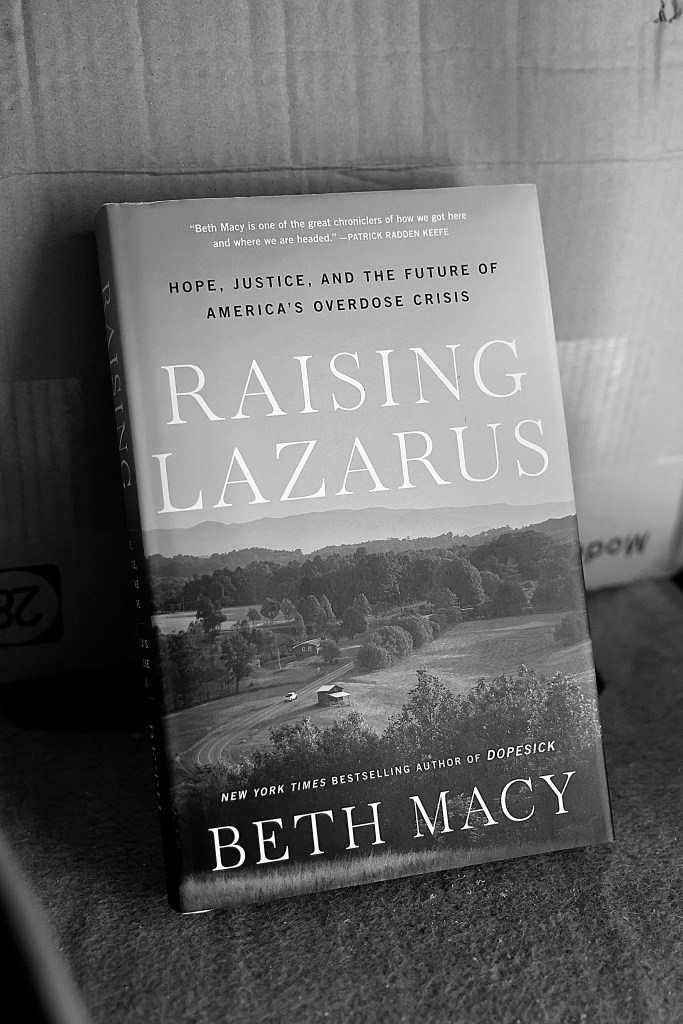
They’re stories that involve universal solutions to a corrosive problem that isn’t exclusive to Appalachia but the work of Nikki King in Kentucky intercepting court-convicted drug users and getting them into her treatment center in the back of the courthouse, the hill Witch of West Virginia covertly delivering clean supplies to localities so that rising rates of HIV/AIDS and Hepatitis can be mitigated, Tim Nolan administering vaccines and driving people to and from treatment all from his Toyota Prius, and so many others offer a glimmer of hope to those who need them. They provide a caring, proven model for the rest of the country. They are people who agonize over and are personally connected to the issue of opioid overdose, people on the ground working tirelessly for their communities. People who deliver support and humanity. They are people who care.
I spent a month reading this book: a month being with those foot soldiers, whether they were checking in on somebody they were treating or covering the Sackler/Purdue trial in grave and merciless detail. And though Macy outlines the many, many obstacles standing in these heroes’ ways, I couldn’t help but feel optimistic while turning the last page. The epilogue gives in excruciating clarity the solutions that work, solutions that save lives and knock down prejudices, and solutions that bureaucracies should adopt. But more than that, Macy really hammers home in all the anecdotes she writes that “the secret to patient care is to care for the patient,” a quote she took from a 1926 doctor at Harvard. And that’s the guiding principle in which one should read this book and look honestly at this issue.
“If I live to be a hundred, I will never forget the image of Brooke Parker, sitting at the infected feet of a calmly weeping man while police officers went about the business of stapling up eviction notices. It was like we weren’t even there, like the earth that we, too, walked on belonged solely to the politicians and bureaucrats and people who were still falling for Richard Sackler’s ‘hammer the abusers’ scam.” (278)
Demagoguery and Democracy
Patricia Roberts-Miller
These next two books (pamphlets are more like it) are actually rereads from college, but like Jane Austen, you see new value in books you reread later, ya know, without the pressure of having to read them.
I read this book for, of all things, a digital literacy class because, despite the title, this book is all about rhetoric and argumentation. Its purpose is to encourage people to be active and educated in civic processes and stimulate critical thinking. She uses many an example from times past, especially World War II (a topic present in many of the books I read in 2023), to provide a framework for how to resist being swindled by demagogic rhetoric and thus be led to think or do things that would otherwise be considered unreasonable or insane.

My favorite part about this book is that the author is a writing professional. She deals with the mechanics of rhetoric, rhetorical thinking, and political speech. Roberts-Miller suggests methods for having better and more concrete arguments, including a section that gives an overview of fallacies and how fallacious arguments can be spotted and avoided. I imagine my professor wanted to impart these concepts in this section of the class.
She uses the example of Earl Warren, a California attorney and former Supreme Court justice who presided over the 1954 Brown v. Board of Education decision, which deemed segregation in schools unconstitutional. But before that decision, Warren employed the language of demagoguery in arguing that Asian Americans should be incarcerated because of the attack on Pearl Harbor and perpetuated perceived threats of Asians living within the United States. He spoke with calm reassurance, even using facts, figures, and statistics that, upon critical inspection, revealed an abject irrelevancy to the argument he was making. His rhetoric reduced complicated and nuanced circumstances to a characteristic “us vs. them” mentality, encouraging the notion that life will be rid of all of its problems as long as “they” are dealt with.
It’s such a sturdy and robust read for being so slim a volume.
“I’ve used Warren’s demagoguery as an example not only because it shows that it isn’t a question of good versus bad people (he did both good and bad things in his life, like most people), but also because his support for and later regret about internment shows that the best way to open the Faraday cage of demagoguery isn’t by aspiring to some emotion-free hyper-rationalism; it’s by practicing compassion for those whom demagoguery says we should treat as Other. It’s by imagining things from their perspective.” (76—77)
On Tyranny
Timothy Snyder
Again, this small pamphlet of a book illustrates twenty different lessons of how to guard against the vortex of tyranny using the 1930s and 40s as examples. I used it as a small source for some sociology term paper back when it came out, but I’ve come back to it since because I’ve noticed that the ways I was taught to think about World War II, whether through high school history courses or documentaries in college, wasn’t as complete a picture as I once thought it was. Like with most things, some factors are more complex: Germans in the 30s didn’t just wake up one day and decide to be Nazis and commit some of the worst crimes against humanity the world has ever seen. It was a measured morass of changing norms, the eradication of societal nuance, and the belief that a mythicized past could once again be restored (as long as “those” groups of people were eliminated from the earth). It wasn’t until much later that people realized the German election of 1932 was the last free election held for some time.

As stated, Timothy Snyder, a multi-lingual Yale historian, writes a concise but compelling list of traits one can notice and recognize when societies start to change for the worse. And he uses solid examples of how institutions that were thought to be inevitably strong and steadfast gave way and prompted the likes of murderous dictators to assume power and maintain it for a long time.
Of the twenty lessons, I gravitated toward a couple, as will anybody who reads this book: Make Eye Contact and Small Talk and Establish a Private Life. It’s these two ideas that I think healthy societies hinge on, and should those activities disappear, life crumbles. Give this a read not only for the historical perspectives but also for future references.
“A patriot has universal values, standards by which he judges his nation, always wishing it well—and wishing that it would do better.” (114)
They Thought They Were Free
Milton Mayer
On the topic of World War II comes this title. I saw this in the library one day, and because I was on a kick of 20th-century history, I decided to get my own copy to mark it up (and it is marked up and tagged all over the pages). After reading it, I can’t believe I was never assigned this in college for any class. I believe this is one of the most important sociological documents of the period, especially for understanding how society changed under Hitler and the Nazis. It’s an incredible primary source for looking at just how the Nazis came to be and who gave the movement legs to stand.
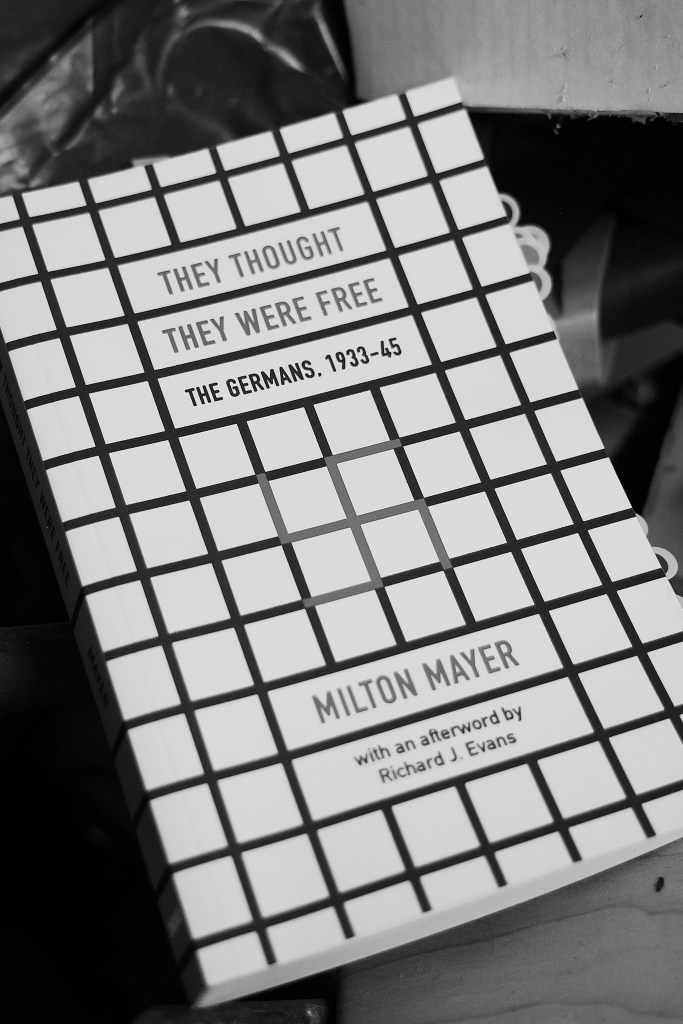
Milton Mayer published this book in 1955, and his original endeavor was to interview Hitler himself. But when he went to Germany in 1935, he understood that he needed to speak with the people, the average citizen in Germany, because it was the Germans that were making up the backbone of the Nazi regime. Mayer befriends ten people, all of whom constantly describe themselves as “little men,” people society has overlooked, people just living their lives. They were men who did not know, in Mayer’s words, that they were slaves.
It also plainly states how the slow creep of the Nazi party blanketed itself into the fabric of society. It hammered hard that these German friends were ordinary. They joined Nazi groups because they were co-opted into organizations that shared the same suspicions that they did and thus began to steep in Nazi ideals. They also shared a fear of resisting a movement that controlled job markets, families, and livelihoods. The ten friends tell Mayer that their only crimes were “being Germans in Germany.”
Like the previous summary, this book introduces a more layered view of World War II than I remember receiving in grade school. This period is overwhelmingly atrocious, and it’s correct to be taught that way. However, understanding the complexities and nuances of the society that led to these atrocities can open up new ways of contemplation and a bent toward guarding against the same patterns from developing in the present and future.
This is an amazing sociological document that should be assigned reading, in my opinion. Little things crept into the folds of society (and rotted there) and became accepted by growing margins of people, thus leading to unthinkable actions being done thoughtlessly. If you are interested in World War II history, this book is a must-read.
“What happened here was the gradual habituation of the people, little by little, to being governed by surprise, to receiving decisions deliberated in secret; to believing that the situation was so complicated that the government had to act on information which the people could not understand, or so dangerous that, even if the people could understand it, it could not be released because of national security. And their sense of identification with Hitler, their trust in him, made it easier to widen this gap and reassured those who would otherwise have worried about it.” (166)
When Books Went to War
Molly Guptill Manning
Back to brighter topics of the 30s and 40s: When Books went to War is a love story for anyone, especially those who live, breathe, and are comforted by books. It’s the story of the Armed Services Edition (ASE’s), a program that established The Great Gatsby and A Tree Grows in Brooklyn as standard American literature for decades. It’s a wonderful recount of how books were treated as essential items for those serving and how soldiers pleaded for them as they were guaranteed ways to escape their immediate circumstances.

Manning begins the book by describing the 1933 Nazi book burnings, re-counting how throngs of German citizens threw out hoards of books deemed detrimental to the German cause and way of life. From then on, she details the extraordinary coalition of Americans that orchestrated the Victory Book Campaign (VBC), a program that donated books en masse to fill military libraries. The VBC was then accompanied by the ASE program that coordinated with publishers to produce small pocket-sized paperbacks, on massive scales, versions of popular books and new releases. This was the first time mass paperbacks really became a driving force of book sales, making it possible for soldiers to carry their tomes through war-torn spaces, foregoing the struggle of cumbersome hardbacks. And Manning describes how librarians and publishers fought for the consistency of government funding to continue these programs. The letters some authors received from soldiers abroad were heartfelt, tearful, and sometimes humorous in their gratitude and appreciation for a story that gave them peace for a few moments. It’s heartfelt and endearing.
The luster in this book, for me, is obviously the subject matter. It’s amazing how so many were mobilized by Nazi book burnings and sought to reverse the course of Nazism by supplying soldiers with so many books. The afterword address that over 100 million books were burned or banned by the Nazi party in its time of power and takeover. The VBC and ASE programs collectively delivered over 130 million books to American soldiers across the globe, defeating the Nazis in this regard as well, screaming, “To hell with that.” It’s a highly encouraging and enthralling read that details the critical aspects of how books were a mechanism of hope for those defending the country, facing turmoil, hardship, and unimaginably antagonistic forces.
“As Hitler waged total war, America fought back not just with men and bullets, but with books. Despite the many advances in modern warfare—from airplanes to the atomic bomb—books proved to be one of the most formidable weapons of them all.” (192)
⌈⌊⌉⌋
Motion City Soundtrack — True Romance
The Paper Kites — Electric Indigo
Recent Rumors — Boulangerie
Wild Truth — No Filter
Vanille — Suivre le soleil
The Struts — In Love With A Camera
Boundary Run — Fly Away


The toilet bowl vortex of life…yes! Sometimes I feel like the stinkbug hanging ten while being incrementally flushed away!
Rather a non-fiction year for you with lots of import. Reminds me that it’s time for a phone fast as I prepare for spring classes. Hang in there!
LikeLike