
A Year’s Review of Fiction
I start this not with an exposition or some personal anecdote but with two recommendations: Annie Dillard’s The Writing Life and Anna Quindlen’s How Reading Changed My Life. They’re sweet, symbolic, poetic, and the endings won’t necessarily make you cry, but they will induce a pensive mood. And they’re both enjoyable.
Dillard’s book is the most metaphorical of the two: she draws excellent comparisons between the act of writing a story and dreaming. It’s about getting enough energy to sit at a typewriter and “walking” nine-dull miles again and again, examining the world just enough for the story to sound convincing and separating just enough so the loud noise can’t invade sacred cerebral writing space. It’s not a how-to book. It’s an illustration, a representation for people who don’t write fiction for a living, and a darn beautiful representation at that.
Quindlen’s book is much more straightforward and a little more accessible. She speaks in fewer metaphors. Not all of us may be writers, but all of us are readers. Readers of traffic lights, readers of our friend’s facial expressions, readers of the forecast. Readers of the headlines and readers of classic tales. For Quindlen, reading fiction is her favorite activity on earth. It’s a vehicle for going places in the world without leaving the chair you’re sitting in. It’s an ode to the lovely way characters live on despite their deaths or destinies amongst the pages of the story. It sentimentally paints and characterizes bookworms as excellent critical thinkers. And it’s a love letter to getting lost in libraries and inside your own head.
Where these two books collide, aside from the obvious “authors write what readers read,” is the strange relationship with the world writers and readers possess. Writers attune their senses outward and try to malleableize a small slice of the world into the covers of a book. Readers attune their senses to the whims and rhythms of the author, exploring the fates of the painted characters. Dillard says as much: “This writing that you do, that so thrills you, that so rocks and exhilarates you, as if you were dancing next to the band, is barely audible to anyone else. The reader’s ear must adjust down from loud life to the subtle, imaginary sounds of the written word. An ordinary reader picking up a book can’t yet hear a thing; it will take half an hour to pick up the writing’s modulations, its ups and downs and louds and softs” (17—18).
Quindlen softly echoes back: “Naming the world: it is what we do with words from that moment on. All of reading is really only finding ways to name ourselves, and, perhaps, to name the others around us so that they will no longer seem like strangers…I am surrounded by words that tell me who I am, why I feel what I feel. Or maybe they just help me while away the hours as the rain pounds down on the porch roof, taking me away from the gloom and on to somewhere sunny, somewhere else” (21).
And that’s what I find joyous about reading fiction. There’s such an acute, nibbling little way in which novels get right to the core of what frightens, what delights, what saddens, and what excites. And to name those feelings so unabashedly or beautifully is what strikes most book lovers so intensely. The authors that write them subjugate themselves to bitter torments (I’d like to believe every author does; some, I realize, can just churn out bestsellers every year, i.e., James Patterson) and live with a mind that just never stops working. Finally vibing with the flow of the author and interactions of the characters is as intoxicating as catching the wave of creativity whenever it rolls out to shore. Whiling away the hours of a rainy day is seamless and easy when your mind is over in West Egg partying with Gatsby or fighting alongside Éowyn as she defeats the Witch-king of Angmar.
These two books weren’t written in response to each other at all, but I’d like to think they’re in conversation. They point to something deep within their respective persons: the writer, trying to boil the world down to fit within a page limit; and the reader, tearing the covers open to reveal it.
These books opened up a world to me this past year. Have a look and get lost in them.
⌈⌊⌉⌋
Peter Rock
Right off the bat, I could not put this book down. The little paperback version I finally managed to track down in my local second-hand shop has a blurb on the back that says, “impossible to stop reading,” and it is obscenely correct. And the most wonderful and haunting aspect of this novel is how swimmingly the story unfolds.

In short, it’s about a girl and her father, their lives off the grid and away from people, and their struggle to survive in their own contexts. They’re inexistent to the rest of the world.
It begins in Forest Park, somewhere in Oregon, where a young girl named Caroline and her father (who isn’t formally named) are searching for scrap metals around the woods to repair the awning of their “home.” They are masters of the forest, leaving no trace of where they travel. They have hiding holes away from their shelter to hide in, avoidant of all passersby. Every so often, father and Caroline will make a trip into town and back so father can perform some clandestine errands and then return to the forest.
Everything is familiar until one day, Caroline hides from an unexpected jogger who later reveals himself as an undercover cop. A team of police comes out and takes them separately from their life in the forest to be questioned and examined. Their lives as they know them are upended for a bit, but after deep scrutiny, they are released into the care and employment of a rancher and equestrian. The story develops from there.
This book is at times beautiful, at all times strange, and forever haunting in the truest essence of the word. It’s misty and mysterious without clearly defined heroes and villains. Caroline is completely unknowing of any way of life beyond hers. Father is shady and manipulative, troubled and traumatized. Their lives are marked by all the distressing things that have happened in it and how lucidly the story swims along. It’s so dreamlike.
Kazuo Ishiguro
I love the world inhabited by Kazuo Ishiguro. I remember reading Never Let Me Go for the first time: the movie had just come out, and because I didn’t read the book beforehand, the visceral emotionality of the conclusion was fracturing. And Ishiguro is perhaps marked for his excellent ability to wrap a unique story around the same set of themes, most notably, memory. And that’s a good component of this book.

Klara is an AF (artificial friend) in a world very familiar to ours. Just with robots. And Klara’s job, along with other AFs, is to provide company to kids, provide them with a friend and confidant, to stave off loneliness. When Josie, an enthusiastic girl who sees Klara in the shop one day, convinces her mother that Klara is the AF for her, she embarks on an adventure she’s sure she is ready for. In fact, she’s not prepared for the abundance of harsh circumstances that await her in this home.
We experience everything through Klara’s eyes. We begin to unravel the conflict, and she does her utmost to provide the best service, mainly to Josie but to everyone she meets. She observes the many moodscapes and wandering feelings and marbled conversations that everyone possesses around her. One of these observations she makes is the immense ability of humans to envelop a wide and vast landscape of emotions and feelings that they can choose to feel and respond to or can suppress any reaction at all. And she is constantly trying to remain in the moment, learning what she herself is thinking and adapting to shifting needs. It’s a contentious subject once the reader is deep into the novel and knows what’s happening, and a wild storyline to portray the lengths we will go to show love and be loved.
This is quite the coming-of-age novel through and through, and I somehow manage to incorporate a novel or two like this into my reads each year. Like many good novels of this kind, the ending is bittersweet, and it left me in tears despite all the tasks Klara was manufactured to fulfill are achieved. It’s a brilliant portrayal of humanity told through the eyes of a robot.
Uwem Akpan
Finally! Barnes and Noble had their half-off hardbacks sale, and I got my hands on this title. My local library always had it checked out. The libraries that could get it loaned all had their copies checked out. And the paperback has yet to be released. But the sale came around, and I bought it knowing somehow I’d like it enough to own.

With some literary fiction, summarizing the narrative is a complex task to accomplish. In short, this book tells the story of a Nigerian book editor that comes to New York on a fellowship and experiences the wonders, the extremities, and the maladies of the United States. But the story of Ekong Udousoro is much more detailed than that. Through his fellowship that brings Ekong into New York to edit an anthology of Biafran War stories, he journeys from tumultuous customs agents, pesky bedbugs, annoying New York landlords, flamboyant racism, and abject questioning that is resultant of unhealed trauma between his past and his friends. Ekong increasingly feels like he’s been brought to the States, to this publishing house, to be the token representative of diversity on the team and must navigate his actions in a calculating way.
Reading some history on Nigeria and the Biafran War would benefit the reader greatly since it is such a heavy undercurrent in the novel (as are the nagging bedbugs). Though the stories the characters tell about the war are fiction, I could feel, as will any reader, how based in reality they really are.
In this story, you get messy people interacting with messy people, some of whom are devious and are only there to be devious, and some of whom are honestly trying to educate themselves.
All Quiet on the Western Front
Erich Maria Remarque
This may be the most emotional novel I read in the past year and probably the most emotional classic I’ve ever read too. It’s an ingenious encapsulation of one of the world’s greatest atrocities and how it stole the lives of many, especially youths.
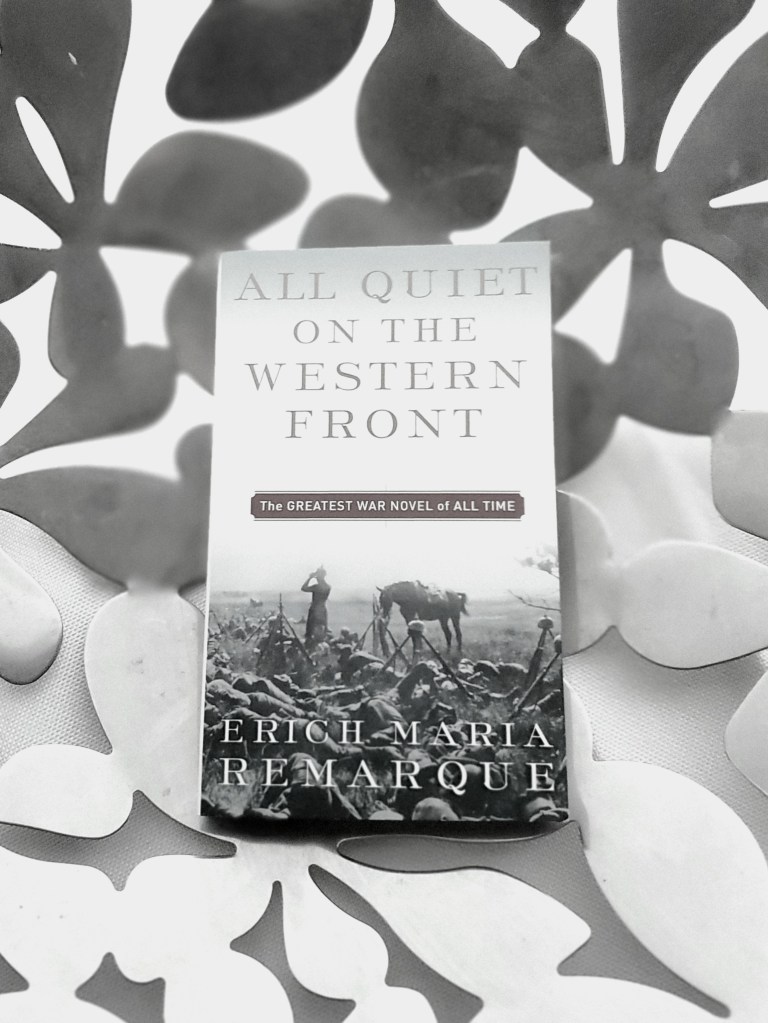
Where to begin: All Quiet on the Western Front was initially published in 1928, and despite how long ago it came out, it is grisly. It turns on its head an idea held by some that books published during this era were chaste and subdued works of art with beautiful prose and luscious imagery. Though it does have beautiful prose, the book is brutal. There are many gory details and descriptive scenes of war and anguish, people getting blown up and mangled and crushed and burned. These descriptions aren’t ornaments either; they’re just facts of the story (in fact, a haunting, early movie advertisement shows two severed hands holding on to a thread of barbed wire fence).
It’s an anti-war art piece that tells all of a young German soldier’s life in World War I, one that my overall impressions stem slightly from a literature class in college: reading Thomas Hardy’s poetry in Literature of the British Isles about “the lost generation” firmly denounces the provocations of war and displays all lack of humanity. This novel, like those poems, shows civilians’ misunderstanding of what is being upheld and celebrated while soldiers who gladly became a part of the war have their entire lives destroyed to the point of hopelessness, if not death. There are many instances where Paul, the main character, says that his comradery is the first and last thing that means anything to him anymore. He crawls across shell holes at the comforting sound he registers as those of his friends. He describes him and them as “forlorn like children, and experienced like old men, we are crude and sorrowful and superficial—I believe we are lost.”
And that’s the story: Paul navigates his way through losing friends, fighting battles, and coming home to a civilian world emotionless and understood by no one, not even his own family. But what strikes me most is how the author so expertly displays how this young generation of soldiers had their youth ended abruptly and their futures stolen. It’s a worthwhile read, but it’s soul-deadening.
Linda Sue Park
Bouncing back from that sadness, here’s a story guaranteed to lift your spirits. This book is simple, short, and sweet, a first-person narrative novel that follows the lives of two siblings living through the Japanese occupation of Korea during the Second World War. It has some emotional boat-rocking, but just keep reading.
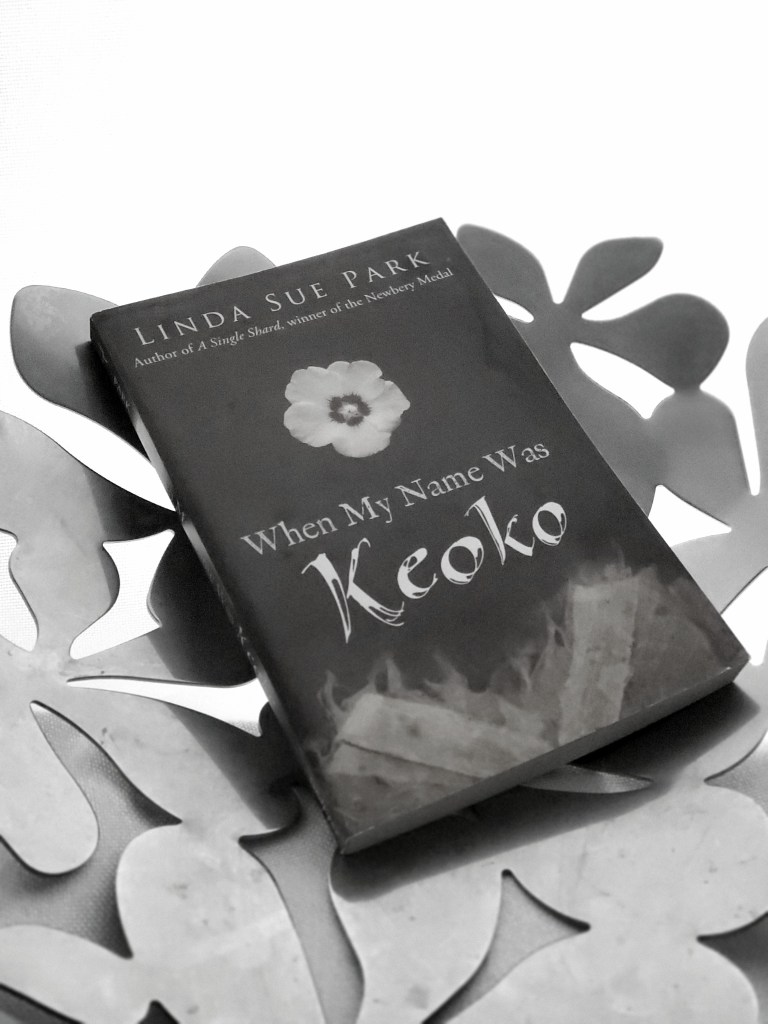
Sun-Hee Kim and her brother Tae-Yul are forced to change their names to Japanese names, erase everything about their culture, and assimilate into the current of a new regime, even to the point of cutting down and replacing their beloved rose of Sharons with cherry trees. Sun-Hee becomes Keoko Kaneyama, and Tae-Yul becomes Nobuo Kaneyama.
The brother and sister must learn how to become who they are while their homeland is occupied by people who want to erase everything that they represent and who they are. They must deal with reality in whatever way possible, be obedient and receptive to their parents, who are loveable but stoic, and understand why it is that their uncle has disappeared amidst his fervent opposition to the Japanese behind closed doors. Everything must be “for his emperor’s cause,” demanding metal, demanding transportation, demanding complete surrender to them. Everything is devoted to furthering the Japanese cause. It’s tragic to witness certain events that happen: Tae-Yul (Nobuo), who loves mechanics, rides a bike he worked to revive, and Japanese officers steal the bike away from him for sport. And these two children have to manage their livelihoods around such traumas.
Regardless, this majestic story has all kinds of dynamic tensions and tension-breakers. Sun-Hee and Tae-Yul, after all, are still children, finding their place in this strange world where their identities are sought to be quashed. Noble decisions are made, sneaky promises are kept, and the family remains intact.
David Guterson
I can remember reading East of the Mountains a few years ago, struggling just slightly because of the complex structure of the narrative. Reading this well-known novel from Guterson proved just how much I’ve come along as a reader because this story is savory.

This novel is a dramatic mystery, literary fiction with a crime at the center of it, and a trial to figure out whodunnit. The story revolves around the murder trial of Kabuo Miyamoto: the death of an amiable islander named Carl Heine leads somewhat directly to the hands of Miyamoto, who claims all-out innocence and obliviousness of the event. It is set, however, in 1954, a decade after World War II rocked the fictional island of San Piedro off the coast of the Pacific Northwest. Miyamoto is Japanese, as are many of San Piedro’s prominent residents. Thus, the story hurls turn after turn, delving into the lives of these characters as they live through the war, how the island becomes divided, and prejudices bubble to the surface, ones that still persist in the courtroom in 1954.
Though the crime and trial are front and center, as are those characters’ personal stories, islander Ishmael is busy running the story for his father’s paper. Ishmael is also entwined with the accused, as he had an affair with Miyamoto’s wife, Hatsue, when he and she were kids. An affair that he has yet to let go of genuinely.
Guterson does a superb job of establishing scene and setting. The novel is atmospheric, the way he describes strawberry fields and snowstorms, embittered courtrooms, and dramatic kitchen table discussions. Everything is sublime despite this being a thrilling mystery story. I can see how the fog over the sound is thick and impenetrable while also resolutely feeling the moment when Ishmael realizes he and Hatsue can’t work together as a couple. The war scenes are chaotic and disturbing and do a good job of explaining why so many central characters are cold and distant.
This is the story of a close-knit island community facing a reckoning with their past, their prejudices and racism, and how they can continue together in harmony. Tension builds and builds in the pages of quick plots and languid imagery, and the reader will reach the end both dreamily and out of breath.
⌈⌊⌉⌋
There are so, so, so many worlds besides this one to discover. Here in 2023, escapism hasn’t ever sounded so sweet. If you’re still looking for that new year’s resolution, something to look back on at year’s end and feel proud about, pick up a book! Travel with it. Sleep with it. Have coffee with it. Always have it on your person. This way, the phone’s temptation won’t be so siren-sweet whenever you’re stuck in a moment of downtime. It’s psychologically beneficial, you’ll definitely sleep much better, and exercising your imagination is the key to a more creative and empathetic life. Judge covers, read synopses, scour the blurbs of famous people on the back cover (where the synopses should be, actually), and if you’re really daring, try this out: Read that last sentence or paragraph. Seriously. If the end of the story is enticing to you, read that book. It’s a tactic that hasn’t ever led me wrong.
And maybe, just maybe, after finishing the read, maybe try it yourself: pick up the pencil or the laptop and hammer out a short story. Even if you think you’re not a writer, try it out. Nothing begets nothing but something may beget something extraordinary. Happy New Year!
⌈⌊⌉⌋
The Deep Dark Woods — The Place I Left Behind
Vacation Manor — You
RICEWINE — Summer Spent
Cold Kingdom — Finally
Field Division — Modest Mountains
Self Deception — Hell and Back
The Ghost of Paul Revere — After Many Miles
Tally Hall — A Lady
 Buy My Ticket Home
You challenged me to do more reading! (and possibly writing) Thank you for sharing your thoughts in a very creative manner.
LikeLiked by 1 person
Some I have read (All’s Quiet), some I have seen the movie (Snow Falling), and some are ripped from the headlines (Klara)….next week I purpose to read more books! I’m always inspired and intrigued when reading your reviews, but find myself prioritizing myself right out of enjoying them for myself.
LikeLiked by 1 person