

A Year’s Review of Non-Fiction
It’s hard to justify why but for some reason, it’s very easy to compartmentalize my life thus far by its series of slumps. Some are small, and some are not. But the feelings, the thoughts, that come around in these periods are everlasting, and even though it seems irrational, it’s been a strange yet helpful tool for me to measure how far I’ve come and, poignantly, how far I’ve yet to go.
For instance, when I hike, I love choosing a backcountry trail at one of my local state parks. I’ve completed many of them here in North Georgia, and I go back regularly to hike them all over again. They offer peace and serenity and quietness that some of the more populated trails just can’t match anymore (though I will never pass these more traveled trails up even if they are crowded). You can hear the wind rustling the leaves and branches, nature stirring, birds chirping, and you forgo nearly all creature comforts. The phone likely doesn’t get service anyway.

There’s a moment, however, where the trail keeps winding on before me, and, though I feel a great sense of awe throughout the entire experience, I drop my backpack, sprawl out onto the forest floor, breathe, and whisper to the bears that it’s alright to take me now because I can barely feel my legs and my lungs creak on inhale. I wish to be transported from the woods to my bed in a warm (or freezing cold) hotel room with the curtains drawn tight, and the difficult terrain remains on the other side of a wall. It’s quite short-lived and dramatic, given that I only need rest to treat this brief bout of ennui before hiking onward.
That’s a slight slump: a quick, expected act of dispassion for a moment while I regain strength to make it back round to the car. Given that these trails are anywhere from an eight to fourteen-mile trip, my slumps will usually happen smack dab in the middle of it, so, really, if I want to make it back to the car, there’s no choice but to continue. And I always return with an immovable languor.
The larger slumps stick around a while longer, placing me precisely in the middle of a valley surrounded by mountain ranges that leap to the clouds. Leaving the security of a full-time job to pursue something within my expertise left me in this valley for the majority of last year. And unlike hiking, there isn’t the safe “comfort” of knowing a bear could be lurking around to take you out of your dramatic misery. Time soldiers on in these periods, and you come to realize that the days roll by just as quickly when steeped in mediocrity as when steeped in fun and sunshine.
For the better part of 2021, I circled the valley, wondering what would come next or what I am to do in life. All other activities naturally slowed to a stop as well. I couldn’t spend my gas every other day driving up to the hills to hike. I couldn’t sit in cafes on off-days sipping coffee for hours. And, for some reason, I couldn’t pick up a book at all during the summer months—well, the traditional summer months of June, July, and August. Here in the South, summer also steals the months of May, September, parts of October, and even a little bit of November sometimes.
I couldn’t pick myself out of this horrific reading slump I didn’t even want to be in. Reading is an escape from the valley. It picks you up and says, “look at these characters, going through exactly what you’re going through. It’s part and parcel of living.”
Eventually, things returned to normalcy—everything typically returns to a lax and leisurely stasis for me when autumn finally returns, reading or otherwise. Things cooled down enough for me to regain motivation not just in reading but job searching, connecting with friends, escaping the tumultuous monotony of the valley. The beauty of reading nonfiction titles specifically points to a truth that’s shared throughout humanity: everyone goes through slumps.
Everyone sometimes loses sight of what they’re striving to achieve. Everyone finds themselves trapped between two mountain ranges, staring up at the peaks, wondering how on earth they’re ever going to climb over to the other side. Stories from and about real people place familiar solidarity with the outside world within the soul; they have worth and power in teaching, in showing, in comforting. Some show the grief and anguish that acceptably come when effort and hard work aren’t rewarded with desired results. Some reveal that you can follow a trajectory you wholeheartedly believe will grant you prosperity in life and still come up short. People’s truths can remind you that you’re not alone in the world.
Nonfiction is perhaps not everybody’s pickle, but I swear, if you’re down in life, deep in woe, within the valley, pick up someone’s memoir and read their life experiences. Their thoughts and understandings of the world can get you thinking, ideating, and feeling again. Learn about something new or take a deep dive into something you thought you knew everything about. The time spent is irreplaceably worthwhile.
⌈⌊⌉⌋
The Art of Living Other People’s Lives
Greg Dybec
This collection of stories is both recognizable and satisfying. And it should feel that way because the author and I share many common traits: he graduated with a BA in English, he has a ton of worry, fears he’s making the wrong choices in life, and turns his screw-ups into life lessons.

They range from witty to truthful to unfortunate to honest in their scope: my favorites were the stories where he tells the reader about landing his first writing job—presenting himself as an underwear expert to actual underwear experts—, listing the most interesting conversations with various Uber drivers in his effort to maintain a five-star passenger rating, and getting a rat high enough to capture and evict from his first New York City apartment.
They’re wonderfully human stories in which one discovers something about themselves, overcomes something that would normally make them anxious, travels somewhere new for the first time, and reasonably handles animosity and conflict. Nothing in Dybec’s book is disappointing. The stories are familiar and comfortable, like sitting down with an old friend you haven’t seen in ages though it feels as if no time has passed.
Something I took away from one of the stories is simply to listen more. He wrote the entire essay about things he had heard in public spaces, things he had observed and seen. I’ve reminded myself plenty of times to listen for interesting, out-of-context bits of conversation as I’m hurrying through the grocery or lingering in the coffee shop. Something to take home with me and wonder about. Something I can turn into stories of my own.
Dopesick: Dealers, Doctors, and The Drug Company that Addicted America
Beth Macy
I consider Dopesick one of the hardest books I’ve read to date. Having worked in pharmacies for seven years, the germ of interest for me was already present, and I picked up the book, knowing already of Purdue Pharma, the Sackler family, and OxyContin. However, it goes much deeper into the heinous world of its marketing campaigns, its ravaging of small Appalachian towns, its destruction of families, and, redeemably, the strife of several people taking them on in court while also trying to undo the damage done by them.
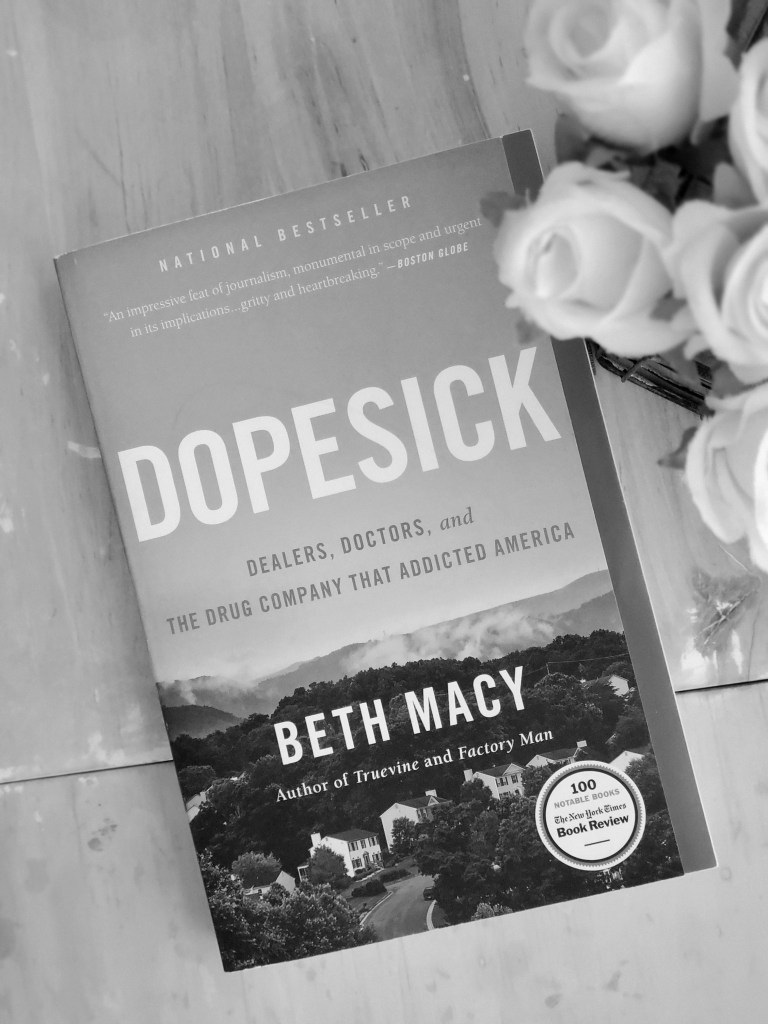
I really feel that it should’ve been titled something like Dopesick: Greed, Misguidance, and Family Destruction because the stories of victims really substantiate the book. Economically hard-hit rural towns were preyed upon by Purdue Pharmaceuticals, a company that celebrated aggressive sales representatives with lavish bonuses, pioneered ever-larger strengths of one of the most addictive drugs, and tolerated shady business practices to continue staying on top in pain relief. The content is split up into three sections: one detailing the life of the drug through court cases brought forth by grassroots organizers and doctors; the next gives a glimpse into the lives of those who had lost a loved one to addiction and overdose; the last shares a hopeful glimmer of an answer to the opioid epidemic.
Beth Macy’s writing and research are both serene and visceral. It’s a book that aims to inform and go after the reader’s heart, aiming to shed light on commonly held stigmas of addiction, outcasted forms of treatment, and, most importantly, offer people’s heartbreaking stories in the hopes of convicting whoever receives them. It is a disturbing book and something I don’t recommend reading before bed. I actually read this twice last year: once in February and the other shortly after the Hulu series came out (in which Macy consulted on and even cameoed in).
Of the two mediums, I suggest reading the book first then watching the series. The book will give you a full and comprehensive rundown of what you need to know, whereas the TV series puts faces to people’s stories. Seriously. There’s a scene in the series in which a central character fights her father as he disposes of pills he uncovered from her backpack. As the garbage disposal rumbles, the young girl is tearing at his shirt, screaming “I’ll die, I’ll die…I’ll die!”
It’s haunting.
Allison Fallon
As a writer, I feel that I’m constantly searching for books, articles, TV episodes, lectures, proclaiming how restorative the act of writing can be. It’s reassuring and validating when someone spends the length of a book describing all the beautiful things writing helps inadvertently. It’s less a divulsion on the how of writing, the logistics and such, and more of a serenade on writing as a means to digest life, to metabolize the events that happen in it, and put words to the emotions and feelings that come from it. Its central idea is that writing is a powerful tool that can be and should be utilized to gain a better understanding of your lived experiences and what you hope to achieve in life.

It’s short, and though it may seem extremely simple, the barriers we can unintentionally place on ourselves that prevent any form of actual reflection (and thus creation) can be strong and unyielding at times. I like it when books are entirely devoted to something we believe to be so simple. Yet we spend so little time thinking about it because we assume that, in its simplicity, we theoretically already understand everything about it. Fallon draws from and makes simple the complexity of neuroscience and how writing can unlock and label the hidden thoughts and feelings that drive our emotional states, our decision making, and affects our relationships.
She even shares exercises to help you get unstuck and overcome blocks in your writing: little activities that have the power to pick you up out of the smallest or largest creative slumps and for when inspiration seems to have abandoned you completely.
The Poetry of Strangers: What I learned traveling America with a Typewriter
Brian Sonia-Wallace
This book came out of nowhere. Strolling the aisles of a Barnes & Noble, glancing through the scant (and ever-dwindling) few shelves of Poetry, Drama, and Literary Criticism, I happened upon this book and bought it. I didn’t have much expectation for this read, but I bought it anyway because the stories promised human connection through a poet with a typewriter. I really wasn’t wrong.

Sonia-Wallace introduces us to how he became the resident poet at many unconventional and fading spaces saying “what do you need a poem about?” to random strangers on a street corner. Much of the book is him asking people what they need a poem about and, after hearing a little bit of their story or their mood or their feelings, he taps out a poem that draws laughter, tears, smiles. Some might call this a strange book, and I can see why they might think that even though I would disagree. He depicts people and communities as to how they want to be seen by everyone: part of something, living, breathing their story.
He engages with different communities, and the results of doing so always shine through these interactions. The book takes the reader on interviews with van life poets, to the poetry rooms at a rave called Electric Forest, through the country on Amtrak, to witch communities in Salem, Massachusetts, to the Mall of America. He talks openly about poetry’s need for people and people’s need for poetry, for their story to be heard and acted on, memorialized in such a way as stringing words together, cultivating feeling and meaning out of the connection.
I don’t really know the audience for this book. I doubt Sonia-Wallace wrote it with someone in mind; maybe it was himself? I can’t answer that question. But this book seems to be for no one and also for everyone. It’s a memoir, for sure, but I feel like it’s something more than that. It feels as though he wrote the book to stretch across the things that typically bind us to ourselves, separate from others because their needs, wants, and desires appear different from ours. But poetry is one of these things that can break through our shells. Some stranger on the sidewalk with an antiquated writing apparatus hears a bit of why you need a poem, and then in an instant, strings words together that can pierce the heart of someone that makes them crumble a little, either into laughter or tears or both. Something that can break through our mundane separation. I think that’s why I ultimately loved this book.
Jedidiah Jenkins
Travel stories are rarely about the scenery. The scenery is a big player, of course, but the real story is what happens to the author or the characters in it. This book is quite typical: corporate office job guy wants a taste of a free life, plans to do something crazy and adventurous and comes back with a renewed sense of self. And again, quite like many travel stories I read, I always begin books like this and expect not to feel much, expect not to glean too much from it. Yet, I always walk away feeling everything. I walk away with some sort of humanity that I didn’t quite have enough of going into it.

On the cusp of turning thirty years old, Jed Jenkins decides to embark on a journey from Oregon to Patagonia—cycling the entire way down despite never having biked for long periods. He spent over a year completing it, and the reader accompanies him through Southern California, Mexico City, Argentina. Across desert landscapes, cascading mountains, and dense, deep jungles. Yet that isn’t all that this book is. It’s also about Jenkins’s inner struggles while on the bike and why he felt that the trip was necessary. He reconciles with his upbringing, at times questioning his belief in God, coming to terms with his sexuality, and juggling the friendship he has with his only other companion on the journey: his friend Weston (whom I found downright irritating, as I discovered, early on, that Jed and I have incredibly similar personalities). It’s a travel memoir in the truest essence.
There’s plenty to criticize, and there isn’t any shortage of less than stellar reviews of the book. Honestly, Jenkins expounds in several places the privilege he has to enjoy a journey like this (you could probably have a drinking game with how many times he mentions craft beer). He even admits how the actual trip didn’t have a super ingenious impact on his overall being and how anxious he was to return to his familiar life. And yet this story, like all memoirs, is someone’s, and they own it, entirely. For me, the story of the unadventurous reconciling and embracing adventure, having a coming-of-age moment or three, is super compelling, and for that, I give it an eleven out of ten.
PS—If you read it, read it outside, preferably in autumn. You’ll be glad you did.
Charles Montgomery
As an Atlanta native, I came to love every single sentence of Happy City—which is interesting given that almost every bad example of design Montgomery uses is of Atlanta.
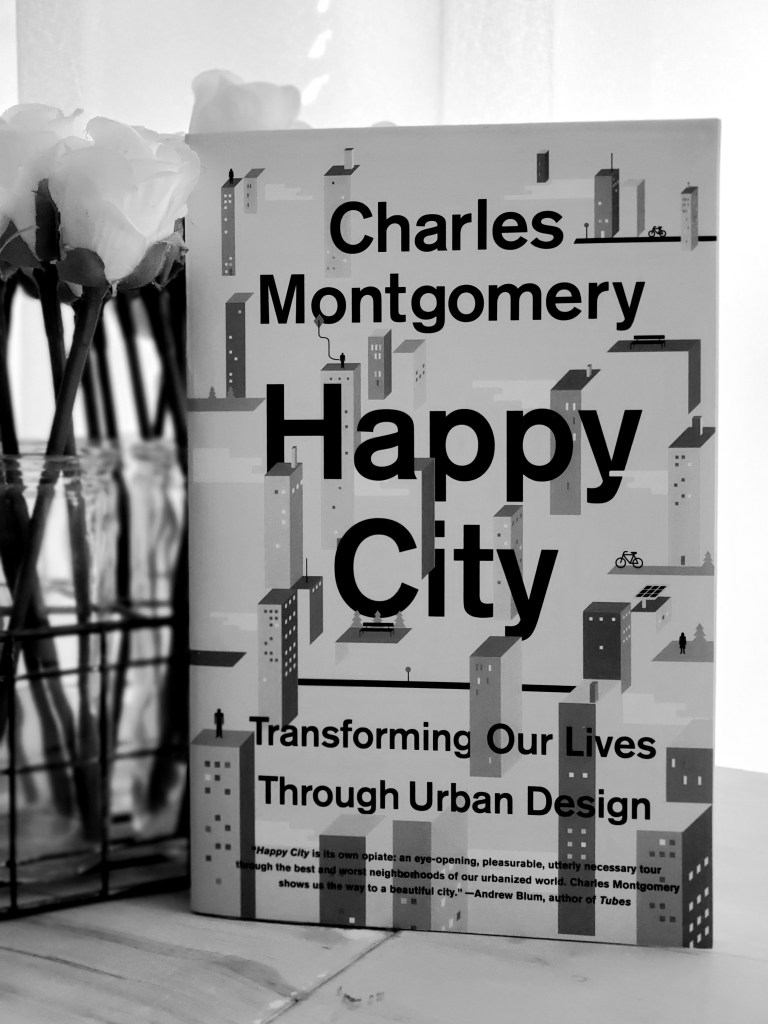
This title is less about urban design and more about the intersection of urban design and psychology. When I picked this book up, I did believe it would hold much more detailed design philosophies, and in a way, it does, but not in the way I thought it would. Montgomery isn’t an architect; he’s an author. He charges the philosophy of dispersal and sub-urbanism with the death of cities and how sub-urbanism raises the cost of every social encounter we have while expertly illustrating ways we can make cities better. The argument the book makes is that we’ve prioritized sprawl as something to achieve the older we all get. We’ve prioritized the automobile as the zenith of transportation, designing our lives and cities and networks around “improving” roads to increase the capacity for more cars. Our streetscapes are sacrificed to the sameness and slab-sided walls of uniform buildings and skyscrapers.
He instead suggests ideas like prioritizing more than one method of transportation by investing in public transit and bike paths instead of remaining dependent on automobile use and road maintenance; creating exciting and dynamic streetscapes by limiting how big-box stores, like The Home Depot, and other establishments can fashion their buildings; setting up attractive greenery outside of living spaces; having more places become accessible to more people. He also supplements these concepts with how moods, health, and social engagement could be positively affected.
It’s quite a balanced, journalistic approach to conquering modern urban challenges as well as a deep dive into some of the underlying ways in which urban areas could positively boost the collective social atmosphere. Perhaps Atlanta, an already great city with some, let’s say, design problems, could be made even better by implementing some of these ideas. It’s a time-worthy, thought-provoking, idea-challenging read.
⌈⌊⌉⌋
Lianne La Havas — Tokyo
Alexandra Shipp, Vanessa Hudgens — Come to Your Senses
MALINDA — Galway Girl
Adele — Oh My God
London Grammar — High Life
Scott Bradlee’s Postmodern Jukebox — Mr. Brightside
 Buy My Ticket Home
Thanks for the reviews and suggestions, particularly for The Power of Writing it Down . I’m reminded how long it has been since I spent much time with pen and paper as I did in high school, college, and the years immediately following. I rationalized that I was going to spend more time living and less time contemplating, but in practice I think that has translated into a sense of disquiet because the thoughts are still there, I just havent been able to distill them and draw them into a neat comforting package. As I enter a big transition in my own life I think it’s time for me to return to the practice of writing it down…..I’m gonna check out To Shake the Sleeping Self, too. I love travel and adventure books, especially those that delve deeper than just a day-to-day account of miles travelled and sights seen. It’s all about the people and their personal and inner journey On my mountain climbing kick…just started Tommy Caldwell’s memoir, The Push.
LikeLike
Great set of books–thanks for sharing. Particularly interested in The Power of Writing it Down. I’ve grown out of that practice over the years and I need to return to that discipline as I enter a big period of change in my life. The Jedidiah Jenkins one looks really interesting. Love adventure tales.
LikeLike