

When I was a little kid, my dad loved to play a band called Saga. He still does. The cover of their album Worlds Apart has a woman on it with bright lips, wearing aviators that reflects an antique map and outer space. Dad didn’t play it too frequently in our presence but when he did, us kids would recognize the opening song instantly, even if we couldn’t recall anything else on the album. He would show us the cover and we would all say in unison “oh yeah, the one with the lady on it!…” or something like that.
To this day, I love that record. I own it on vinyl and it’s one of my most favorite.
I can recall my parents (and to some extent, my siblings) doing things, playing things, telling us things that have had a profound effect on my life and the things I enjoy seeing and doing. Had my mother not had a childhood in Africa, I probably wouldn’t have as much of an appreciation for other cultures as I do. Had my Dad not taken us hiking, I probably wouldn’t be as adventurous or love trees as much I do. Had they not read stories to us, I more than likely would despise reading. Had my parents not shown us The Nightmare Before Christmas, I probably (actually—I know for certain) wouldn’t be as coooooool as I am…or pretend to be.
The memories associated with stuff like this have so much sway over my life as a burgeoning adult (I’m nearly twenty-four, but I assure you, dear reader, that I have no idea what I’m doing). And I assume that I am not a unique case. Everyone can point to silly or defining things in their childhood that shapes what they like and how they relate to it later on in life.
This post particularly is about one of those things, how it has come to mean so much to me as an adult, and what it’s role should probably be in the future for everybody. I knew I was going to write about the Biltmore Estate at some point, but I didn’t know how to shape my story with it. But after reading a few books, I think I’ve found a rhythm.
Keep your arms and legs in the vehicle at all times and try to hang with me.
…
There is Biltmore paraphernalia all around my parents’ house. Paintings, pictures, a little-molded figure of the house on the dresser. It wasn’t hard to see items like this. It wasn’t hard for me to become interested in them. I wonder, even, if seeing and hearing about this magnificent house (a house that was somewhere in the world, as I had no idea a castle was so close to where I lived) shaped my original desire to become an architect. I know for sure that it sparked an interest in design. And big houses.
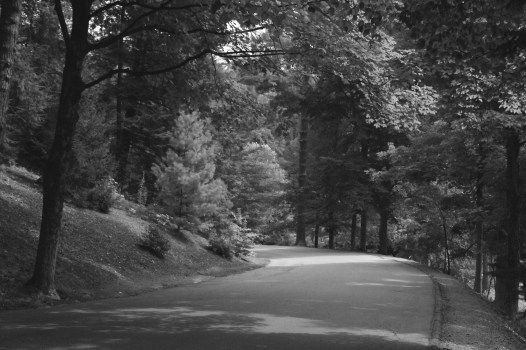
I grew up seeing pictures and hearing stories from this place and my first distinct memory of it finally came one year. Going through the gatehouse, winding and twisting through this forest that seemed to last for AGES, and then coming upon a sudden and splendid field with fresh cut grass and precisely groomed foliage. One side had intricate steps and the other a gigantic house. Absolutely baffling to my young, developing mind. Then a longer journey through the rest of the estate had my eyes shifting around the trees and waters, forgetting entirely my spatial relation to the rest of the state…or country. The place had this magical effect on my brain, not too dissimilar from that of, say, Disney World. Just, more formal.
Coming back home from that trip, I’m pretty sure I voiced some ridiculous thought like “Why can’t our house be like that?,” much to the detriment of my dad (who has invested so much in the house I grew up in). I had also not accounted for the fact that the entirety of my parent’s house could fit comfortably within the space of the gigantic library. I had no idea.
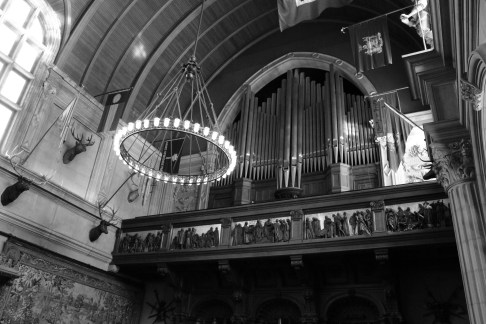
Very few places can capture a mind quite like this one. Even fewer places can hold it. But Biltmore does, and my family makes an annual trip to tour the estate at Christmastime. If I’m ever in town on one of my escapes from Atlanta, I’ll try to go then too.
…
The book I finished reading a little while back is entitled Places of the Heart by a neuroscientist named Colin Ellard. It’s a fascinating book and I recommend everyone read it, even if you’re frightened by the word neuroscience. Ellard examines the basic premises of how we interact with built spaces and what our psychological reactions look like when we consider a tree or walk down a bustling sidewalk. Why do we become fascinated with a building? Why do you like your favorite coffee house? Or why do we feel more alert and attentive when taking a more scenic drive home? Though not specifically, Ellard answers questions.
It wasn’t extremely difficult for me to think of Biltmore while in the midst of this book.
My romanticizations aside, the place is just interesting. To anyone who doesn’t know, Biltmore remains the largest home in the United States, it entertains over a million visitors a year, and it’s located in the Southeast. However, it’s more than a house. It’s eight thousand acres (down from 125,000 or so—that’s National Forest acreage now) of forests and trees and ponds and fields. Every acre is an invitation to play and wander. A cool experience for tastes to be broadened and the finer things in life enjoyed. It’s a place for family and also for solitude.
But, like, why a million visitors?
Last year, whilst looking down from Diana (a sculpture of the goddess looking down towards the house and beyond towards the mountains), I asked my dad, curiously, “why is this place still here?” It wasn’t a question of doubt or discomfort, but just mere curiosity. What could possibly attract people here in this age? The house is pretty much the same from year to year minus some seasonal decorum and the gardens will always have pretty flowers. The mountains don’t really change either. It’s rather expensive too. Ellard has some answers for me.
At least, I think he does.
…
There have been heaps of evidence in the last few years that proclaim nature as a necessity for the brain. Ever come back from a trip to the mountains? Ever felt depressed when you return to your home, your urban environment…or is it just me? Neuroscience suggests an explanation for that. Your brain desires a place in which its roots hail from. Nature is riveting, engaging, consistently dynamic and ever-changing (vastly different than the dynamic and ever-changing Twitter feeds—same plane, perhaps, but immensely opposite sides). It doesn’t exist in a vacuum. It is unpredictable. It is unexpected. And the mind simply relishes in that. Just staring at a tree when you’re feeling uninspired can ignite thoughts and ideas!
Can you see where I’m going yet?
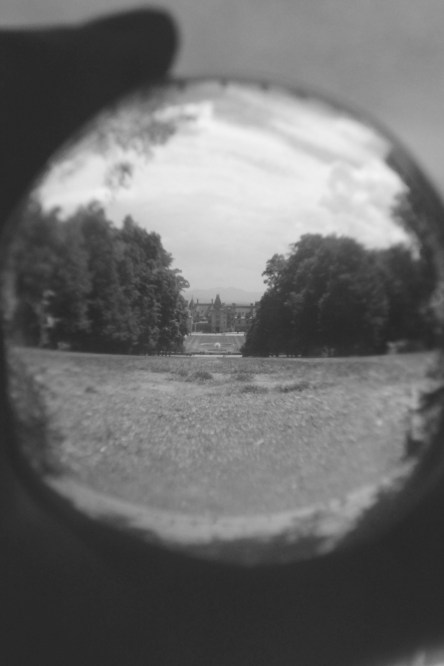
George Vanderbilt, Biltmore’s creator, sought solace in the comfort of the shadow of Mount Pisgah and the lands around it. Given that he grew up in a crowded, albeit lavish, apartment in New York surrounded by a stifling upper-class citizenry and its tabloid presses, it makes sense that he began buying up acres upon acres in the southeast for his architectural masterpiece. It would also make sense then that people would start paying money to see such an open space and experience the same feelings. Perhaps even feel the same obsessions. It’s an oasis of nature and good architecture: one designed for opulent views and such, but an oasis nonetheless.
Ellard mentions an idea he calls “Real-world stumbling,” which happens when we find some new or novel thing without looking for it. He makes the case that the internet has quickly become the sole place where go to “stumble” for novelty. Vanderbilt went a different way than his peers, placing his mansion in the North Carolina heat and humidity, snow, and ice whereas everyone else stayed in New York. It makes sense. We get lost in the void of new things (or trends) on Instagram and the like all the time. Playgrounds like Biltmore inspire real-world stumbling. The entire first experience with the Estate is a three-mile road the twists through forestry! It takes you out of the day-to-day and it makes the real palpable again. It’s exactly what Frederick Law Olmstead, the architect of the gardens, intended: anticipation.

It’s almost like a roller coaster. Ellard says that “what a roller coaster delivers over the course of a few seconds of gut-wrenching, adrenaline-gushing experience is really a metaphor for what we all cherish—the unexpected.” Though not of the gut-wrenching sort, that three-mile journey makes your heart beat faster and at the same time relaxes you. Here we are waiting to see a castle. Anticipation. It focuses your mind on what’s around you and affecting you in the moment. And it’s super cool:
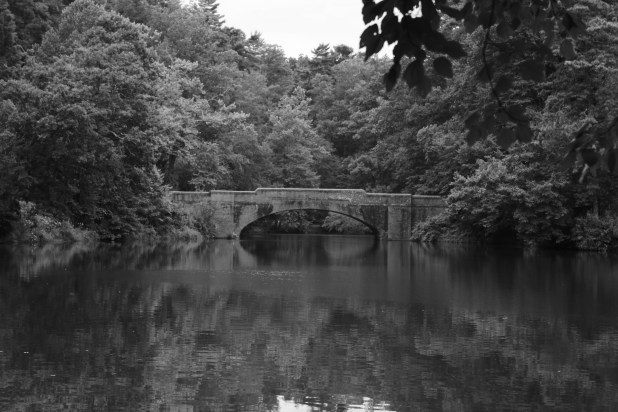
“Those rare moments when the traveler encounters the unexpected, when the journey breaks down and rules are broken, are the moments when we wake up and pay attention.” Why the drive through the forest to get to Biltmore house? Why take the scenic drive home? A fulfillment of focusing your senses on what’s to come and expecting the unexpected. This idea carries all throughout the estate.
…
And so, the house, arguably the hallmark of Asheville.
“Such experiences bring us outside the narrow confines of the body space, encouraging us to believe that our existence constitutes more than just a beating heart inside a fragile organic shell.”
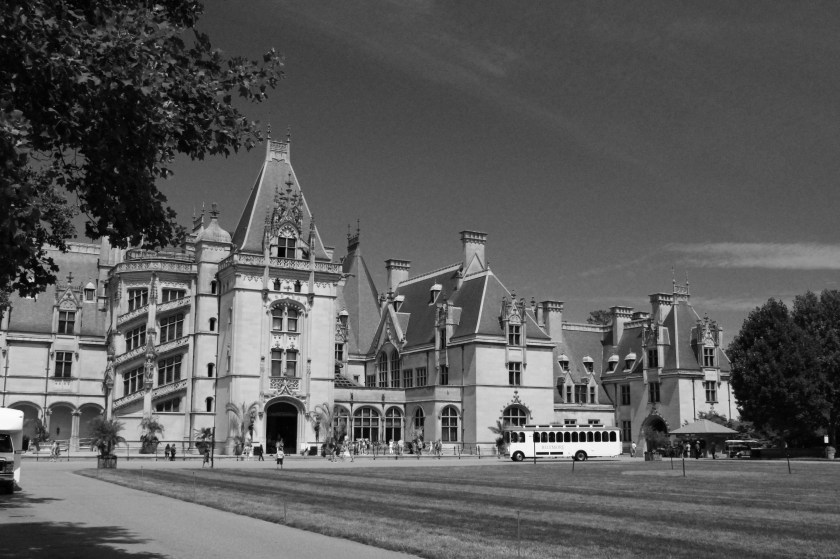
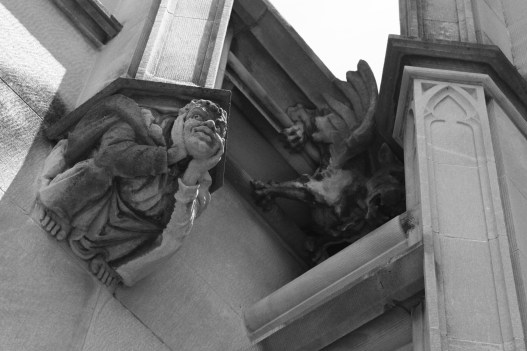
Please don’t excuse the drama of the awe I feel every time the house is revealed to me from behind the trees as childishness. I do actually become a child looking at something novel and extraordinary. Every time. It’s too cool. I take in the details. I notice the blooms, and the fullness of the trees down the drive, the colors of the forest and mountains beyond the spires. Having to look high and low to see everything. I probably see a gargoyle or some stone carving I hadn’t noticed before.
I could take residence in that house and spend a lifetime gallivanting among its numerous details and still not see all of them.

Touring its rooms really makes you feel small. It certainly makes you feel plebian but small more than anything. “Stumbling” upon all the collections of art and furniture and materials demands your attention. Captures it, more specifically. The gardens are no different: they’re an orchestra of shapes and colors. It brings you outside of yourself, hence the quote from Ellard’s chapter on Places of Awe. I’m so glad he spoke of awesomeness.
At least from my perspective, I can’t really say as much of Atlanta. Or even New York City for that matter. These places are awesome, yes, but in a less than tantalizing way. As a tourist to these places, walking in and about the city sidewalks do not really elicit any of the same kind of awe other than the heights of the buildings and the multitudes of people. Sure, places like the Georgia Aquarium and the Empire State Building offer some breakup in the monotonous architecture of these places, arguably, but not on as grand a scale, I’d like to say. Also, those structures were perhaps built to their environments, as the Aquarium is meant to house large tanks and the Empire State Building housing large amounts of people.

The architecture of Biltmore House and its gardens are a monolith on the lush landscapes but it blends with simplicity and surprise. It was designed with the eye of the beholder in mind. Perhaps I’m comparing a strawberry to two avocados, or classic orchestral music to monotone pop melodies, but hopefully, it makes a slight bit of sense. In my experiences being surrounded by a place like Biltmore Estate, a place of careful design and consideration, helps realign my attention. It’s my hope that it does the same for the hundreds of people that go too.
Ellard has a powerful line: “We may not care about what our surroundings look like because we are not paying attention to them as we used to.” Good architecture, good design, could change that, which is his whole point. Being in a place like Biltmore could be a first step.
…

I love my vinyl records because it forces me to listen to each song, in original order, fully and completely. No shuffling. No skipping to the next track. No rewinding (unless I restart the entire album). Not even mentioning the wonderful sound a vinyl record has, it’s a throwback to when a listener didn’t know what to expect of a new album, more or less. I think Biltmore, and places like it, has the same qualities. It’s a time capsule, yes, but on top of everything it represents, it’s simply a place that forces us to slow down and walk. To notice things. Small things and big things. To feel the breezes and to look up at the trees. A pleasant distraction from our phones. A place to read (and write) without much interruption.
Biltmore is one of a few things that has taught me much, but what tops it all is knowing that it’s still in existence, that people still want to visit, and that it promotes a slow-down-and-contemplate-the-roses type of mentality. I would want it to exist forever and ever for that reason.
I’m glad that I have memories of my dad playing us Worlds Apart, just as much as I’m glad that that poster of the house is hung in my parent’s bedroom.
…and glad for, ya know, The Nightmare Before Christmas.

…
I had a few extra things that I saved for the bottom of the post. Obviously, a few books influenced my thinking on this subject, most notably Places of the Heart: The Psychogeography of Everyday Life. Here are the pages for those quotes:
“Real-world stumbling…” —(208)
“What a roller coaster delivers…” —(84)
“Those rare moments when the traveler encounters…” —(84)
“Such experiences bring us outside…” —(152)
“We may not care about what our surroundings…” —(122)
I highly encourage everyone to read it.
It’s pretty easy to figure out where I scribbled most of my thoughts down for this post and surely, this won’t be my last time writing about it. I may even be on my way there right now. Who knows.
…
- The Paper Kites—Don’t Keep Driving (Their entire new album, actually)
- Lord Huron—In the Wind
- Aquilo—Who Are You
- The Oh Hellos—Grow
- Milo Greene—Wolves
- She & Him—Stars Fell On Alabama
- Aretha Franklin—Do Right Woman-Do Right Man
- Bon Iver—Michiant
- The Weepies—River from the Sky


This should be published in paper! So evocative! It makes me wish you could travel to Europe and tour all those old, old castles…
LikeLike