

A Year’s Review of Non-fiction
The Graveyard Fields in Western North Carolina aren’t what the name implies they are. Nestled in the valley of tall southern Appalachian peaks, this expanse of land ripples with lively vegetation and, at times, a torrent of a stream called Yellowstone Prong. Its summers are overwhelmed with every shade of green, and in autumn, the leaves cast vibrant reds, yellows, and oranges before everything turns a reclusive brown in the winter.
And it’s always crowded.
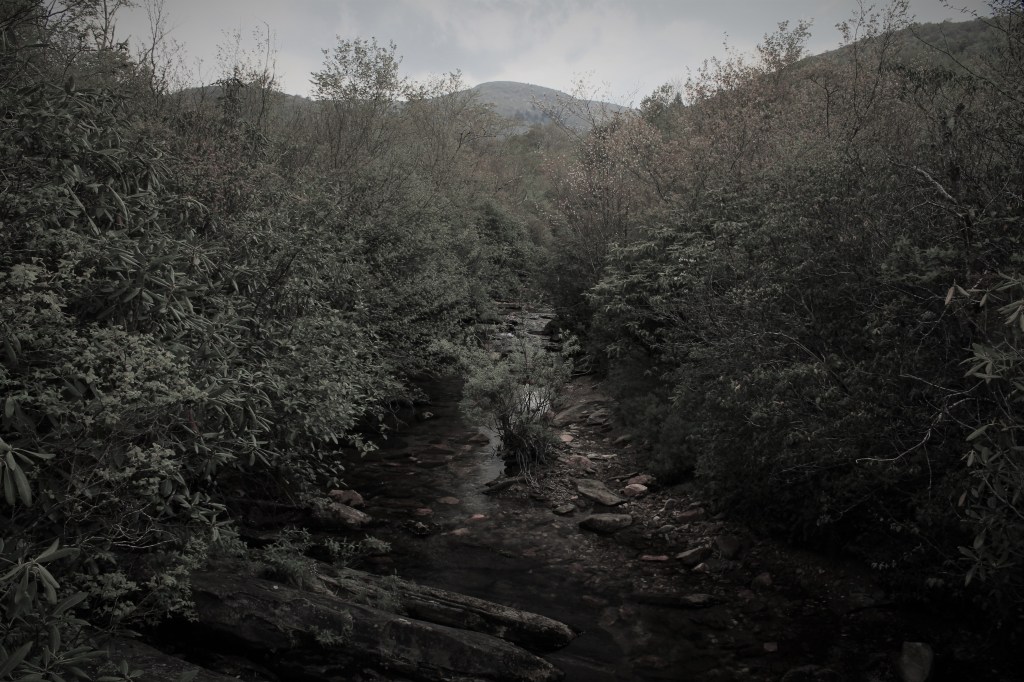
I pass these fields on almost every trip I take to those mountains, winding up into the high wilderness of the Blue Ridge Parkway. And the access lot to the fields is generally always packed, which is why I had yet to stop there. I’ve hiked most of the Shining Rock wilderness but never this. It’s a completely recognizable area because the trees become sparce and spaced, and the ground becomes much more prairie-like and grassy. All at 5000 feet above sea level.
The milestone marker tells hikers that moss-covered, wind-blown tree stumps resembled gravestones before a fire devastated the landscape in 1925, sterilizing the ground. And I finally saw what it meant when I shut my car door in the lot one weekday in late spring of last year. Reports of possible rain didn’t look feasible then, with the sun poking wildly at the fast-moving clouds. But one should never conclude, based on their first step into the mountains, what the weather will be like for their entire trip.
I made my way over the fast-moving stream, cold with mountain runoff, and the paved trail became dirt, rock, and a little shelly. There’s a number of waterfalls located in this part of the area and getting to them requires a couple of miles of hiking through some dense shrubbery. And boy howdy did I lean on my map. Since the fire devastated everything here nearly a century ago, the land is pretty new: its trees, its flora and fauna, its dusty paths of interior adventure. You feel like you’re inside something adverse to everything else surrounding it. The trees aren’t towering over you, and the grasses creep over spongey dirt like a marsh. All the while, the high peaks loom in the distance reminding you that you aren’t on the coast. That’s what probably makes it so dreamlike.
When I inevitably slipped up and chose the wrong course, I found myself walking along two rails of boards strung from the dirt path and through willowy trees that reminded me more of Spanish moss in Savannah than anything in the high Appalachians. Another wrong course took me to the bank of another stream, this time stiller and glassier, and I grabbed shells from the earth as if I were at the beach and not high in the North Carolina mountains. I let the dirt and tiny shells fall through my hand, noticing the clouds looking a bit darker and my confidence in the sun wavering.
Nevertheless, I finally made it to one of the falls I came to see. Lack of runoff deemed what is usually a crashing fall a tiny trickle, making its somber way down the rocks. It wasn’t spectacular like the pictures I’d seen. Whatever. I still relished what I had come to see despite my disappointment. Without warning, I heard something worrying. The steady beat of rainfall was approaching and knowing then how much I had messed up standing three miles from my car, I began trekking back. No use. The trickle of a brief mountain shower became an overbearing ambush. Much like the mist that wraps the mountains in early morning, the rain obscured vision so thickly you couldn’t make out tree trunks mere steps away. I hugged the trunk of a large pine tree and stood there for a second (listening fervently for the sound of thunder, which, fortunately, never materialized), hoping that this method of staying dry would keep during this brief but driving onslaught. It didn’t.
I stood wrapped around the tree for God knows how long, wishing wildly for the rain to stop. My camera bag, full of filters and lenses, is water resistant, not waterproof. Groups of people rushed past me, braving the downpour. They’re mostly laughing at this bout of bad luck, but I am genuinely frightened that I might have ruined camera equipment when I arrive back at the hotel. Maybe I’m speaking out loud or just loud enough in my own head, but I’m passionately praying for the storm’s end so I can make my way back to the car. By then, the giving tree isn’t giving. I am soaked to the skin, and even though it’s a balmy spring day in the mountains, hypothermia is still a real threat. My mind was seething.

Somehow, someway, I ran through the rain along with a couple I had passed a few times on the hike. They were super nice newlyweds, making pleasant conversation with me despite how anxious and flat-out angered I felt. They shouted through the pelting rain how they were on a road trip from Florida and hadn’t expected the downpour either. No longer did I feel alone in my poor-decision making. I don’t remember how we navigated the vast expanses of trails and deep gullied trenches, but we ended back at the bridge to pavement and up the stairs to the parking lot. The rain conveniently dissipated entirely, and the sun’s rays lit up the valley. Nearly an hour and a half of rain pounded the ground, and only now when I was under covered solace, did it cease. I fumed.
I wished my new friends good luck in their adventuring and a happy life together, gathered a towel I always keep in the trunk, and grumbled all the way to the pit toilets to dry off as much as possible. Luckily the tarp I also keep in the trunk managed to protect the upholstery from my soaked clothing. The clouds rolled on in blissful travel, and as I rounded the tunnel at Pisgah, heading down the leeward side of the range, no evidence suggested anything of the storm I had just experienced. As soon as I was showered, I rolled into the warm hotel bed and didn’t make any other attempt at hiking until sunset was upon the skies several hours later.
Maybe that’s a “living life on the edge” experience. No, it isn’t an ascent of Everest or a deep-sea dive to the Titanic or hiding from an F5 tornado. But it was unwarranted, surprising, and effectual in finally getting me to purchase that rain poncho I should’ve had anyway. Maybe my camera bag wouldn’t have taken in an inch or more of rainwater from that excursion. It was something of life that, albeit unpleasant, was engaging, forceful, and a story I’ll never forget.
But life isn’t always like that. Most of life is relatively humdrum, the exact opposite of melodramatic. Maybe that’s why we English nerds are trying to decipher symbolism in every piece of fiction we read (much to everyone else’s chagrin). I find those humdrum stories equally as fascinating because they capture someone in the daily: stories that offer glimpses into the world of another, whether it be a deep dive into their beloved profession or their criticism of it, whether it be a day in the life of a professional climber or an accountant. They are stories that evoke a response. Some people have happy tales to tell. Others lived through their tribulation and share their experience in the hope of welling awareness in the reader. For us, it’s an exercise in empathy, compassion, understanding, and education.
My daily life doesn’t involve enduring pelting rain while making my way through the mountains of Western North Carolina—thank God. It’s just a perk. The sun lights up the forest, most often to where the smell of pine radiates in the air. If you’re looking for a story that bridges the daily with something unique like that, have a look at these.
⌈⌊⌉⌋
Bryce Andrews
Thank God Bryce Andrews has another book coming in 2023 because I read his two current books way too fast. Both of them can easily pull on the heartstrings, but his second published book is a bit more somber. You also can’t seem to put it down.

After leaving a year’s work on a ranch in rural Montana, Andrews went to work for the small nonprofit People and Carnivores, an organization that seeks to minimize conflicts between big predatorial animals and humans while educating the population on safe practices and conservation. Through his work, Andrews comes to know a man named Greg Schock, who’s having problems with grizzly bears in his cornfields in the Mission Valley of Montana. Andrew’s job was to devise a way to deter grizzlies from entering “the stand” and getting to the corn. He worked with local wildlife biologists to wrap the field in three-wire electrified fencing replete with cameras to watch activity throughout the days and nights.
The main story cuts in and out of the life and death (that’s not a spoiler, the subtitle declares it so) of a bear named Millie and civilization’s creep into the remaining wild places of North America. Millie becomes acclimated to the seasonal patterns of corn growing down from the mountains where grizzlies like her hunt and scavenge for their food, passing on traditions to their young. In moving about closely with human territories, Millie had come to rely on the corn instead of what lay naturally in the high peaks. The reader endures the tragedy that inevitably befalls Millie as her close encounters with an encroaching human world leave her dead and her cubs in captivity.
It’s an enthralling story lyrically told through Andrew’s eyes. His adept language is solemn and languid and keeps you turning the pages. It imparts a great deal of wisdom on grizzly bears as well: their habitat, how they move, how they adapt, how they operate, and how they scavenge. It imparts a great deal of knowledge just on cornfields, a subject I apparently was ignorant about despite attending corn mazes several times in the autumn months. A black and white ariel photograph in the book is like a where’s Waldo puzzle: spot the bear in the corn. It isn’t as easy as it might seem.
The book illustrates in a single example how human activity crawling ever so closely to traditional wilderness is harming desolate areas meant for just the wild. It’s sorrowful and likely to leave a sense of despair instead of an overwhelming feeling of hope. But a movement of feeling is sometimes an impetus for realistic and impactful change.
Timothy Egan
It’s only 251 pages with a three-page epilogue but the text crammed into those pages is so rich with information cleverly laced with commentary on its subject matter. It makes sense because the Pacific Northwest is rich not just with high mountains and an eccentric atmosphere but also in its history and conflict.
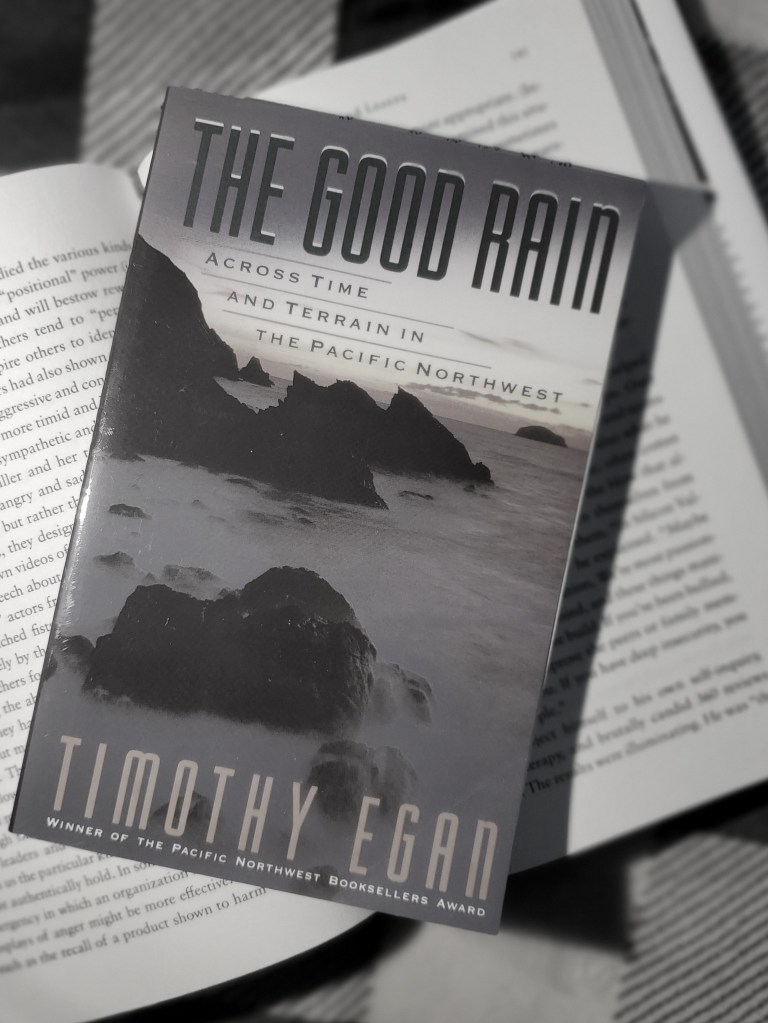
Timothy Egan is a well-known writer today but I hadn’t read his work until my uncle sent me this book, conveniently, after reading Down from the Mountain. It’s a collection of stories Egan tells with the through-line of a voyage made by Easterner Theodore Winthrop in the nineteenth century. It begins with Egan saying goodbye to his grandfather’s ashes upon Winthrop Glacier, and he begins to wonder why this craggy ice heap has a Puritan’s name attached to it. He thus embarks on the same tour of the PNW that Winthrop enshrined in his memoir, The Canoe and the Saddle, many decades ago.
Published in 1990, many of the topics Egan discusses are still relevant today and expertly make the reader parallel the past with a possible future. Several natural Northwest treasures, many with tribal significances, along with the laws of nature were contorted and changed to fit the desires of the moment altering not only the landscape but people’s relationship with it.
It’s been a while since I had thought about the Mount St. Helens explosion of 1980: reading this chapter made me wonder why such a catastrophic and relatively recent volcanic event wasn’t covered to its core in my earth science classes. Fred Beckey gets his own space and is memorialized here as an avid and critical adventurer for America, summiting several peaks out in the Northwest. The logging wars, the atrocities committed against native tribes, the fights over dams, and the deserting of lush spaces have their space too. And the story of how war was averted because two armies standing on opposite sides of a border got to be friends in the time they waited for the other side to strike first (a war, by the way, started over the death of one man’s pig).
It’s an exciting, somewhat depressing look into the Northwest and an excellent introduction to Egan’s writings. Many of his subsequent books are now nudged into my TBR.
Susan Cain

Are you the type of person to savor rainy days, adamantly listen to sad music, and find it easy to identify the sentimentality in life? Well, hello there; Susan Cain wrote us a book that validates our inclinations! The bestselling author (and TedTalker) of Quiet weaved an excellent perspective into the inner workings, the why, the what, into those of us who wax melancholic, who tend to look at the “sanguine-choleric” (charismatic, loud, smiley) landscape of Western culture and find it challenging to find our place in it. And to be honest, it’s difficult to really explain what this book is about without sounding clinical.
Some might argue that the book’s messaging is off and aimless, but I’d argue that with the subject she’s trying to tackle, it’s difficult to describe to people who don’t get it. Yet the tour she went on to answer the question “why do I like sad music so much?” is winding and unpredictable.
Through various journeys into seminars, history, and personal storytelling, Cain expertly constructs how bitter and sweet, light and dark, fresh and foul so intricately intertwine, and why it’s necessary to experience both. She issues an eclectic blend of research that spans interesting studies in psychology and neurology, as well as a dive into different traditions and how they balance the darkness and light of life. A sheen of memoir glints in this book, too: Cain uses her own experiences with losing family members, mother and daughter struggles, and her fascination with longing to illustrate why feeling sadness and poignancy is essential to a full life. Some of the most sentimental and memorable moments spring from feelings like these.
If you hope to read something unique and guaranteed to make you think, I’d suggest starting the year off with this. It’s wonderfully poetic and, as the title suggests, perfectly touching.
Ivan Doig
In Denver, there’s a beautiful theatre-turned-bookstore called The Tattered Cover, and I picked up this unsuspecting memoir from the regional section purely because of its subtitle: landscapes of a western mind. I expected great descriptions of twentieth-century Montana. I didn’t expect to cry.
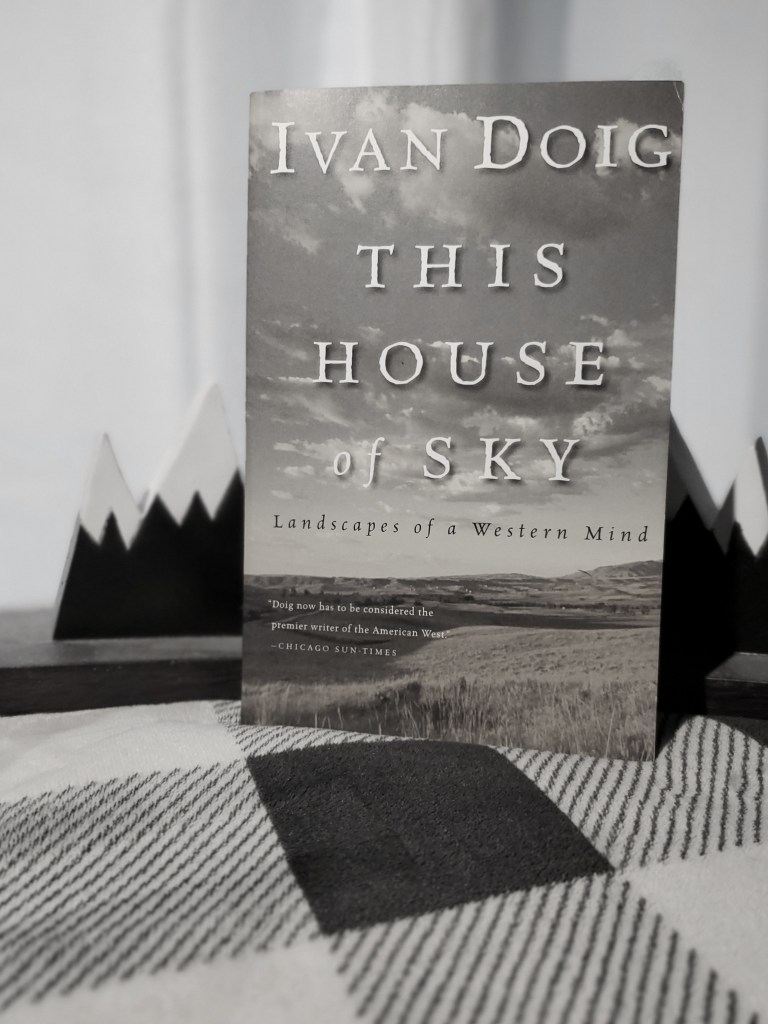
The book indeed has such sweeping imagery of the mountains and the flatlands and the townscapes that Ivan Doig grew up in and around, but this memoir is more of a love letter: to family, to memory, to the fortune of being together, to time, to hard work, and to Montana. The story of a family dynasty unfolds in its trials and hardships. It begins with the death of Doig’s mother when he was six years old and continues with his father raising him entirely on his own for a while, through a tumultuous failed relationship with another woman. The bulk of the story settles around the happenstance twist of fate that Doig’s grandmother comes to live with them throughout the rest of her life. It ends with the passing of his father and grandmother.
The stories he tells of ranching and moving house are phenomenal. The scenes are fully rendered, so much so that I have a full picture of what life looked like in White Sulphur Springs from the late 40s and 50s. Extravagant similes, peculiar metaphors, funny witticisms, and moving personification encapsulate a multi-generational memoir that makes the reader well with tears at its conclusion. It’s a great book about the passage of time, how it weighs down on a person and how bittersweet it feels to be grown, to witness time flying by, like a subway train roaring past you on the platform.
The author and the people he writes about are long gone today, but his surviving words are powerful and jolt the reader exquisitely into the past of the American West; a truly stunning and worthwhile read.
Peter Zuckerman and Amanda Padoan
Many are familiar with Krakauer’s famous disaster story of Mt. Everest in 1996. I read that too this year and hopped on the bandwagon. It really is one of the greatest adventure stories ever lived and written. But this book has another edge to it. And on a different, more dangerous mountain. The most dangerous mountain, actually.
Buried in the Sky is the mega-journalistic account of K2’s most disastrous and deadly excursion on an August day in 2008.
The authors write a different through-line than most books of this kind: they focus on the people making these expeditions possible. The Sherpas and porters are the main characters and the story is mainly told from their points of view. They stake out to set rope, pitch camp, make trail, and, most importantly, ensure their client’s safety to the best of their ability. A lot of research went into this story’s vigorous narrative and information, including several trips to Nepal and Pakistan.
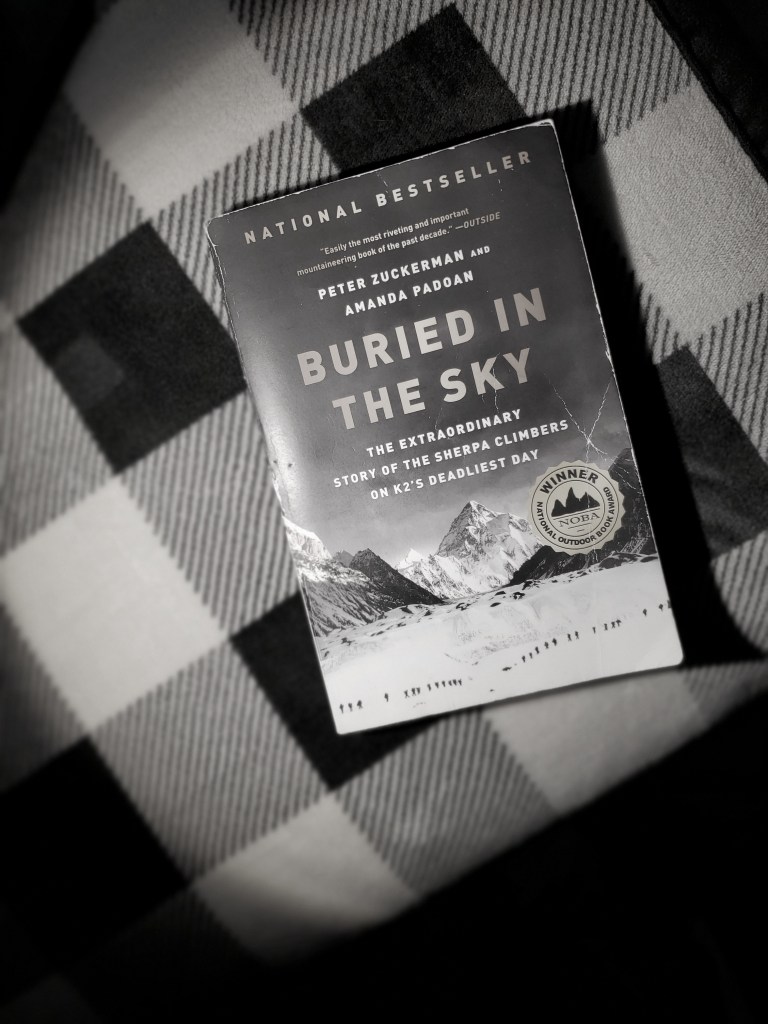
This book gave me nightmares in ways Stephen King never has. Eleven people perished during this expedition, and their deaths are dreadfully unsettling. It was a flurry of broken communications and poor decision-making, but bad luck was also in the mix there. K2 is notorious among climbers as being the most dangerous mountain. It’s the world’s second-highest peak, and part of the story is devoted to its history and legend. Whereas Everest has come to be characterized as a tame, low-stakes ascent (in terms of pro-mountaineers), K2 is a much riskier undertaking.
Ever since I learned about the earth’s highest summit, I’ve dreamed about what it’d be like to climb it and be on top of the world. Yet, in the middle of this book about a different mountain, I realized that I had never even glimpsed at a book on the subject. I learned so many things about mountaineering. And what my dream looks like now is still captivating though new fears hamper my vision. The human body endures a lot at over 8000 metres. We can only derive a third of the oxygen that we can get at sea level. Red blood cells are produced more rapidly at that altitude, increasing the risk of blood clots. Hallucination is very wild and imminent, as is the possibility of severe frostbite and amputation. Corneas can freeze.
This is ultimately a story about a fierce overcoming of catastrophic circumstances, and it is excellently disturbing. It’s a horror story. I’m recalling the descriptions of a point on the K2 ascent called the bottleneck, a place with massive seracs hanging off the mountain on one side and sheer drops on the other. Climbers must shimmy their way through this narrow corridor. The creaking sounds those glaciers make, like far-off thunder echoing amongst the rocks, is terrifying even to imagine.
Michael Fanone and John Shiffman
I don’t normally read these kinds of books, and that’s perhaps a mistake because I savor memoirs. And that’s ultimately what this book is.

I’ve followed Michael Fanone since he first came into the spotlight for his heroic deed defending the Capitol on January 6th, 2021, so when I saw he coauthored a book on his experiences, I met it with interest instead of derision. It isn’t what I thought it’d be. The first half is about his history going from a directionless young person to having a sense of purpose to the truly honorable police officer he is (or was) today, winding around his time in training all the way to entering the MPD. He offers exceptionally sound and reasonable advice on how bolstering police training is the solution to policing problems (especially citing that more gun training under duress is necessary for wielding said weapons). He reminds the reader of what public good comes from the services of cops who do their jobs well. His closest confidant and friend he came to know through his work was a black transgender woman named Leslie, who helped him understand his community more and recognize the genuine problems of the people he served. Those stories are truly touching and show what an impact good cops can have on communities riddled with harmful operations. He gives a good sense of who he is, his work ethic, what he’s about, and his character. And he’s really, really down to earth and likable, a self-described redneck.
The actual story of his experiences on Jan.6, though, is horrifying and angering. He spares no grisly details or disturbing facts—no shortage of profanity either—about the calamity that happened and the fallout succeeding it. There’s no whitewashing or sugarcoating. He suffered heart attacks from being tazed repeatedly at the base of his skull. He was beaten relentlessly with the pole of a Blue Lives Matter flag. He was pulled into the mob and had his life threatened with his own weapon. Even afterward, his struggles with PTSD and anxiety added to an already stressful aftermath. He was subject to unwarranted scorn from his own colleagues for doing his job protecting people.
This book is unsuspecting despite its high-profile subject matter. It left such an indelible impression on me, so much so that I read it three times (one of which was the audiobook narrated by Fanone—highly recommend). The thing I’ll take away most here, though, is just the integrous character greatly relayed through his story—more power to this guy. He uses this opportunity to not only share his account but to remind people about the humanity in police work, urging for more robust training and scrutiny for those who choose to enter the profession. Fanone proves to be someone of good faith and integrity, who stands up for what’s right regardless of who they are or what they represent, and someone who serves to protect everyone. Even unfazed jerks.
⌈⌊⌉⌋
Colter Wall — Snake Mountain Blues
Gillian Welch — Revelator
Vacation Manor — You
Andrew Belle — Spectrum
Penny and Sparrow — Thunder
Marieme — Rogue
 Buy My Ticket Home
“It’s just a perk.”
That’s how I’m going to frame my challenges in life. Just a perk of another day on the planet.
LikeLiked by 1 person