

A romanticist goes West
As fall descends on the Northern hemisphere, I’m thinking of the summer’s beginning, hot and thick as summer could’ve been this year. Colorado was a token trip that quelled the worst of the seasons’ symptoms, and I wanted to relive it a little bit in writing. I wonder what the aspens are doing right now…
⌈⌊⌉⌋
In January, I meandered about the galleries of The Booth Western Art Museum in Cartersville, Georgia. I observed the magnificent representations of the American West, its wonders, and its pot-holed history. Depictions of cowboys, cavalrymen, soldiers, ranchers, and Native Americans fill the galleries. Painters and sculptors had also crafted all the extremities in scenes of light, rock, and water in their creations, and in viewing them, the familiar call of the mountains began invading my headspace. Who knew when that call would be fulfilled, where the winds would take it.
However, an opportunity swiftly presented itself, a plane ticket was arduously booked, and, touching down, I could feel excitement creep over and swallow all other emotions. Here was the West. Here’s what was calling.
The mile-high city greeted us with scenes that were neither postcard portraiture nor calendar-photo perfection but something else entirely familiar. It was distinctly northwestern. A curtain of gray shielded everything from sight save for the base of what made my heart flutter instinctively: the base of rigid mountains. The air was temperate and drafty, and in the vein of past fashion choices, my tank, shorts, and thin sneakers I left hot, humid Atlanta in were palpably useless in the country of high elevations. I saw droplets of water rolling by the window of the descending plane and already began to try and curb expectations. I am typically the one who disappoints myself and if this trip was going to happen in the weather, so be it. I may have been touching down in the West, but the next six days could’ve been engulfed in continuous weather. Plus, if hiking in mountainous land holds any lesson, it’s that almost everything is unpredictable. The spires of peaks are fickle, and in a short hour, everything could teeter toward one extreme or another. Either way, here was the West, 1,400 miles away from home.
⌈⌊⌉⌋
“Wealth I ask not, hope nor love, Nor a friend to know me; All I ask the heaven above, And the road below me.” Robert Louis Stevenson, The Vagabond
Our third day finally brought out the sunshine. We staved off despair for two days of shrouding precipitation, and the sun debuted itself for the rest of our time, melting off the clouds and revealing the orange and green hills of the Front Range.

We had secured spots to hike the Manitou Incline on this day: slightly famous at this point for being a retired cog railway, opposite the Pike’s Peak depot, where hikers destroy themselves climbing up the side of Mount Manitou. It’s a little over 2,700 steps made of old railway ties, with a 41% average grade (and, yikes, 68% in some places). Thank goodness the sun came out otherwise our view from the top would’ve been spoiled a bit after so much exertion and effort. I was in the best of spirits knowing that this would be the only hike of the trip, and, on the surface, it does seem like nothing more than picking your knees up repeatedly until you reach the top. As my uncle would recount to me, knowledgeably and facetiously, on our ascent: “you have the gift of youth, but I have the benefit of experience.”
Sure enough, my excitement could only carry me up, say, 700 steps before exhaustion started settling into my joints, femurs, ankles, and brain. It’s an ironic way to realize that life isn’t eternal and not everyone is capable of such simple maneuvers as bringing your knees near your chest multiple times in pursuit of a beautiful view and glorious satisfaction. But as sure and stark as the timberline, my legs became Jell-O, disabling my excitement a little. Trees on the side of the ties provided cool and refreshing shade. Much of the path angles differently than in other areas, and sometimes the top goes out of view, shielded by the sheer grade of the railroad ties until it levels off slightly. I marveled at the hikers daring to make this their descent: surely I’d fall and tumbleweed all the way back to Manitou Springs.
The path summits eventually (not on Mount Manitou but close enough), and you look over your shoulder at the little scar in the landscape shimmying down the hill, getting smaller and slenderer. The Garden of the Gods looks like little deformed lego pieces jammed into the hillside to the northeast. And Highway 24 scurries off to the left toward Woodland Park. My uncle and I take our “proof” pictures and help others with theirs; then, we begin the hike down: a much more gradual winding trail that serves as the “give up” trail at several points on the incline. These points afford a cop-out route to those who’ve had all the steps they can conquer.
There are many sweeping views of Cameron Cone, with its rocky gray spines canopied over by conifers and the railroad chugging up its valley toward Pike’s Peak. A bright red train passed, blowing its shrieking whistle, and I thought about what it must be like to hike these mountains in the snow. And this trail revealed the range of colorful landscapes that I’ve come to define this region of the state: cracked boulders the size of Suburbans hanging off cliffs surrounded by rod-straight or crooked pines and the subtle hints of orange earth spreading through the cracks. It looked like half an Arizona desert mixed with forested Canadian hills. And the horizon’s hazed line levels out like a rough transition into a calm sea. I could’ve imagined the shimmer of the Mississippi river glimmering across the immense flatness stretching out toward the East from my point in those mountains’ crevices.
⌈⌊⌉⌋
”My heart is warm with the friends I make, And better friends I’ll not be knowing, Yet there isn’t a train I wouldn’t take, No matter where it’s going.” Edna St. Vincent Millay, Travel
A small parking lot that services both the Manitou Incline and the Manitou/Pike’s Peak Cog Railway belies how many visitors there actually are. We were fortunate to ride and be dropped off by family at the colorful, Scandinavian rail depot, where several people also waited to board an 8 AM train up to America’s mountain. I shivered with the brisk morning winds primarily because of excitement (I stayed that way throughout the trip). My parents considered the spectacle of the Manitou Incline, asking questions about how difficult it is. My dad gritted and sucked his teeth, said, “I’m glad I didn’t commit to that.”
The Pike’s Peak Cog Railway is a historic track that has operated for over a hundred years. Much like reading a classic book, I felt nostalgic standing in the spots of many privileged travelers up the slopes of such a prominent landmark in the western facade and lore. Instead of steam engines, a recently upgraded train from Europe opens its doors, and our tickets are scanned. A high whistle pierces the forests around as we depart.

The train articulates around curves in the track, and though it’s a cog keeping us from flowing back down, the ride is relatively smooth and genteel. We’ve got assigned seats from our tickets, and the three of us have a conversation with a kind lady from Germany in our pod. The conductor, in full uniform, is cracking dry jokes and relaying facts about the surrounding scenery. I struggle to simultaneously learn more about our lovely new travel companion and gawk at the rocks strenuously balanced in the air above the track. There’s much to see around us: pine trees sticking up toward the clouds, small burbling streams that we can hear through open windows, and small ravines that look threatening to the track, the land rising immediately to balance it and prevent it from warping disastrously.
It’s a steady incline for the first half of the ride, then the tops of the trees become more visible. Timberline breaks, and the track ambles skyward. The conductor, still amid her talk about the landscape, walks up and down the cars; however, to the seated passengers, she looks as if she’s climbing, grasping the tops of the benches to steady herself up and down. At various points, descending trains pass us while we wait in a siding, and when the train resumes movement, it lurches forward without grace.
Soon, there aren’t any trees to look at but a barren montane landscape. Lake Moraine sits below us to the left, deep in the valley of a few peaks, and beyond that, Colorado Springs, blurred by distance. We round a corner, and soon rocks take over all of the ground where scarce green lives. Disorganized, coarse rocks are everywhere, and we make the last ascent. You can feel the power surging through the bearings of the train as we push up, and finally, the incline eases. The train stops. An hour has passed.
On ascent, the train passes an area called Windy Point, presumably named after its precarious location in the path of strong gales. So, it’s strange exiting the vehicle and feeling no wind plaguing Pike’s Peak. A temperature of thirty-six degrees Fahrenheit reminds us of our good choices in attire, though we notice a few tourists hadn’t thought that much ahead (one donning a thin pair of sweatpants and an Old Navy t-shirt). Several cars are parked in the lot, which, ironically, is much more expansive than the lot back at the train depot. And the vastness of the sky stands behind everything. It’s weird to look at—some—mountain peaks from the ground and imagine yourself teetering on the edges, trying to balance yourself when the top is wide in reality. And there’s security in knowing you won’t have to balance on any edge unless you want to play chicken with death.
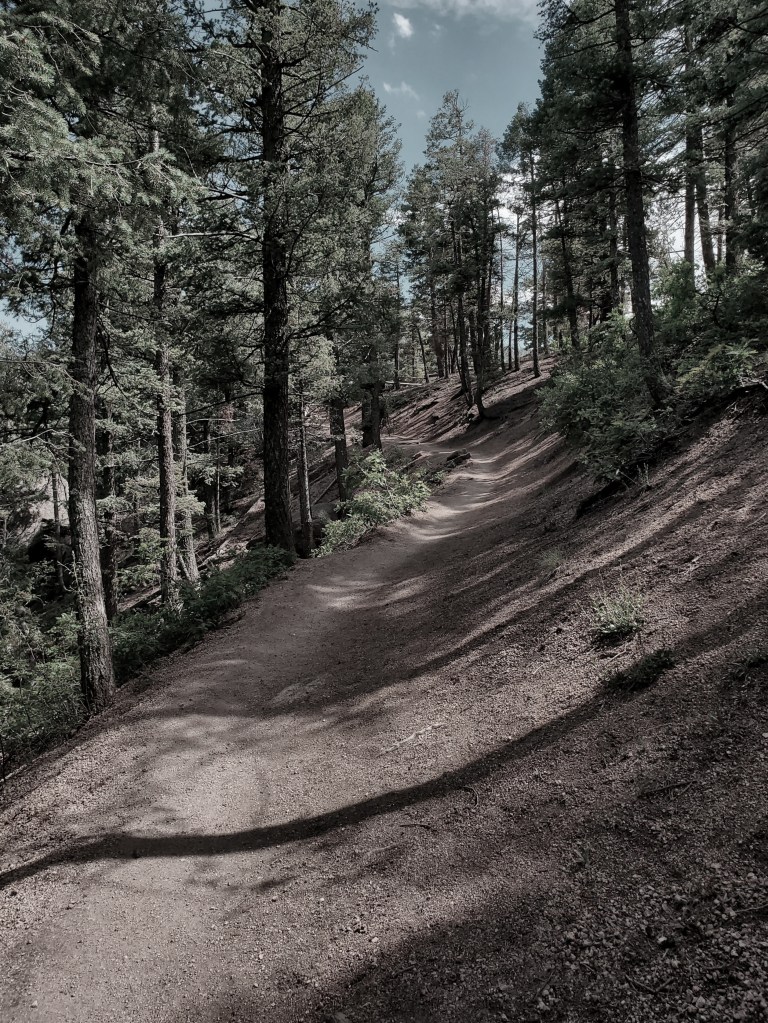
Like in the last third of the ride, the ground is composed of rocks and dirt. Some packs of dirty snow hide in shaded corners. Nothing else. Everything the eye lands on is unfocused except for the ridges and spines of the range racing toward even ground. The mines of Cripple Creek are now effortlessly seeable, as well as the more pointed peaks to the north, splattered with snow. I wandered, losing my crew in the process, elated at how high I now stood once again, feeling the brevity of history and looking out, thinking of how travelers must have felt on the first ride up or, further still, how exhilarating a feeling must’ve materialized at this mountain’s European discovery. I make sure to consume a “you-gotta-eat-one” donut, rush through the brief exhibition in the newly minted summit shop, buy a hat, and scurry about the overhangs and platforms. The rush is necessary because, absurdly, the train leaves to travel back down in a meager forty minutes. The conductor quips: “What do we call passengers who don’t get back to the train on time?…Hikers.”
The summit of Pike’s Peak is a wonderous spot that’s a blur in my memory due to the visit’s rapidity. Riding back down, descending at such steep rates, I felt the inertia and the brutality the brakes of this train must have been suffering, steadily rolling down the cogs at a speed that I guess was less than fifteen miles an hour. We spoke of the experience with our friend and talked more with her about her time as a filmmaker in South Africa and her ambitious future. The trees became window height again, and soon they towered over the rails. After an hour, the train returned, dropping us onto the platform to pull off our jackets as the temperature in the valley had already climbed to a high degree.
Pike’s Peak, in a word, is sublime, if momentary. I feel my short time atop its dome was rather peculiar and not like what the summit sees most of the year. Wind didn’t whip around, clouds didn’t cover views, and the cold didn’t bury beneath the skin. I imagine how lonely it is up there when the sun’s shift ends. I’d catch the stare of the peak on our other travels around that area, and it would bare us a solemn farewell when we left for the last time.
⌈⌊⌉⌋
“Out where the world is in the making, Where fewer hearts in despair are aching, That’s where the West begins;” Arthur Chapman, Out Where the West Begins
The pull of Colorado is many things, but among them is one of America’s most beloved national treasures: Rocky Mountain National Park. It’s one that’s been on my list since I was little, and I heard tales of its prominence from family members and then from subsequent books and hiking guides.
The drive up from Colorado Springs presented a variety of the state’s topography and foliage. Colors become much more lush and primary rather than dusty and desert-like. Through Castlerock, then Denver, off the highway and into Boulder, passing away from big towns as well as flood warning road signs, scampering past the highway town of Lyons, and on into beautiful Estes Park, the snow-laden mountains erupting behind the quaint village. Diverging West in pursuit of Estes Park was like entering the twilight zone in a way: at some point, the road curves southernly, the bouldering hills rising past the sightline of the window, and trees become much more abundant, greener in the way I’m used to back East. And an ever-slight western incline keeps your ears on edge and adjusting.
I was a little despondent during this part of the drive. Clouds had gathered. Though I’ve indeed internalized by now that the mountains are volatile, able to swirl up the weather in ever more crooked and mysterious ways than the last, I still was mourning a washed-out National Park that hadn’t yet come to pass. And sure enough, once through the gate sitting behind many other parkgoers and driving south towards Bear Lake, the sky began to spit and precipitate once we’d reached our first landing.
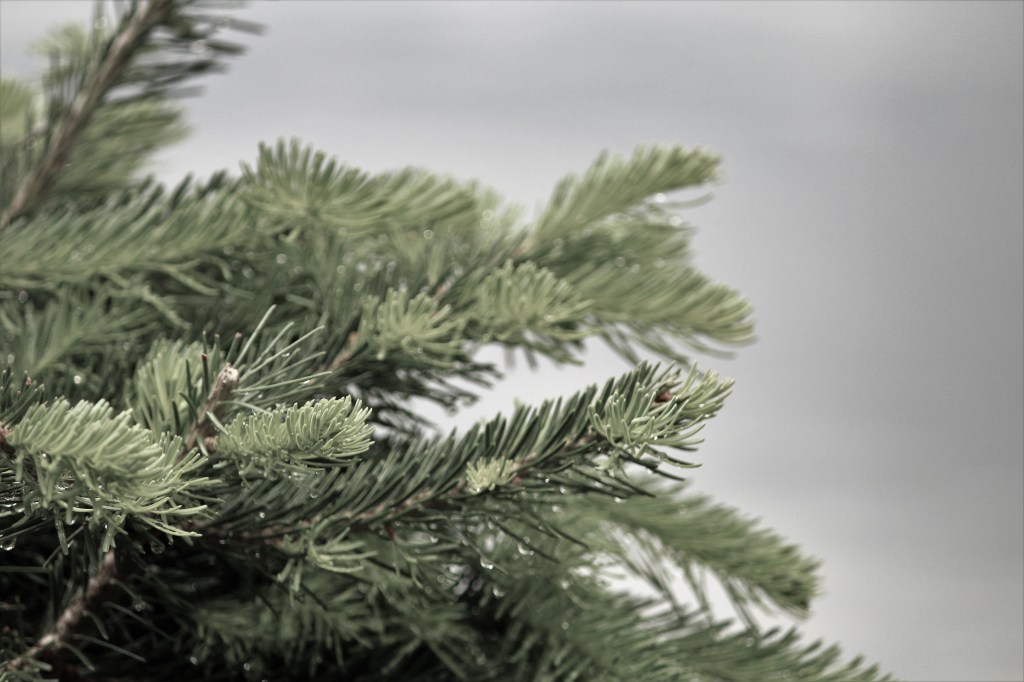
From the Bear Lake Loop, tall pines stretch toward a lofty atmosphere shrill with the sound of pelting raindrops. The smell of Christmas bore heavy in the damp air. We could just make out the flat-slabbed ridge of Hallett Peak up in the far reaches and the taller twinkling gleam of a peeking glacier once we stood at the lake—which is just a large pond nestled within several running slopes of mountains. Seeing as though the rain and clouds would beat on us the whole time, we forwent the loop. I chose to be gleeful; I still saw the sights and was able to return to a heated Subaru seat.
On the way back down (and en route to get gas in Estes Park), we passed the trailhead to Alberta Falls, and on a whim, not knowing when in fact, we would be in Rocky Mountain again, almost all of us disembarked—my mother stayed behind refusing the dampness outside. It was still quite wet, chilly, and gusty, but when in a place as golden as this, a thousand miles from home, one takes the opportunity to adventure and then recuperate. As luck would have it, the sky broke open and let sunlight rest on the slopes above us. The rain ceased, leaving a monstrous flow of water running through the falls. We got incredibly close, enough to feel the rushing spray and take pictures before turning back. In the newfound temperateness, we drove back to Bear Lake and took the circular trail around since it was now possible without sacrificing our dry clothing.
It stayed this way throughout the rest of our trip, and with gratitude, I smiled at the heavens for granting me a glimpse of Long’s Peak before going home. We stopped for lunch in Horseshoe Park below the highway that would take us higher into the mountains, and on this road, circling a ridge to point us further west, Long’s Peak stood in radiance outside the surrounding clouds. The rises of rock up its Northern side glowed in the sunlight, and though I knew lethality hid in its ridges, the hike looked manageable from a distance (even though I’ve only scrambled a mountain once). I wore that silly child’s grin proudly until we got on the return.

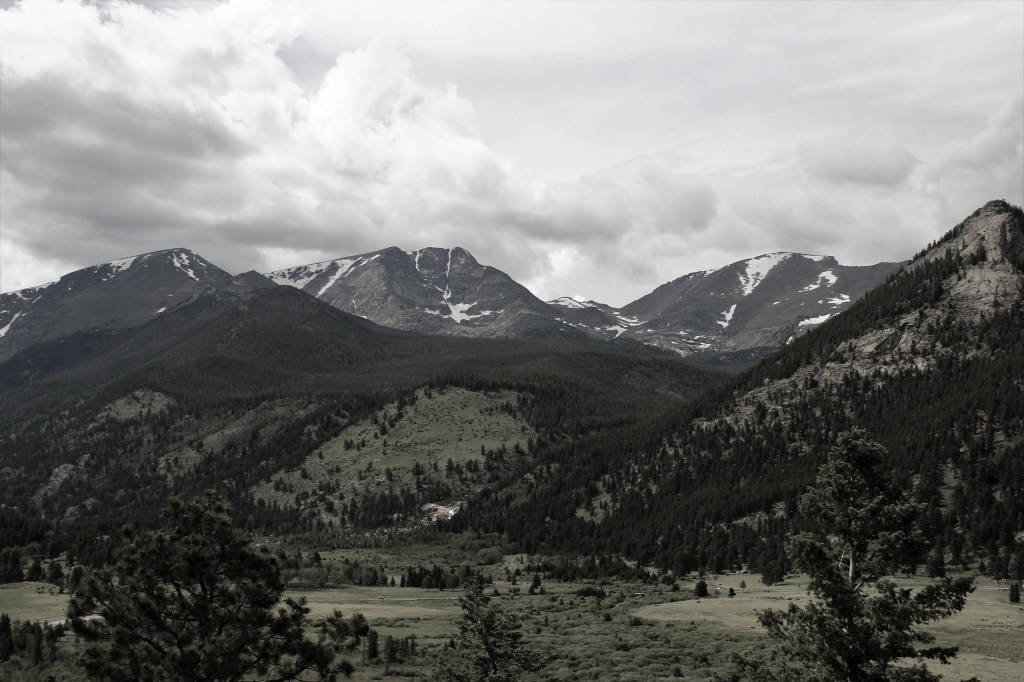
On account of my parents, we didn’t endeavor to hike much though half of me wanted to say, “drop me off here and pick me up in an hour.” The other half lauded the time I got to enjoy with family. The road wound up and eventually summited (12,183 feet above sea level), the trees refusing to follow upward in a sweeping tundra. Rocks, moss-like grasses, and fungi-adjacent flowers sprung up from the earth. And around us spun the mountains of the park, mountains I see in dreams and National Geographics. Snow-capped and piercing the sky, lines flowing down and then back up again, bowling in deep gullies that looked harmless to my eye yet surely receded by hundreds of feet. Stoney gray melding and mixing with the deep greens of vegetation. Little lakes pooled in peculiar areas, and trees crawled up chasms as far as the elevation granted.
At several moments, the road fell off the side into a vast forest that left sinking feelings in our stomachs and hesitancy in our psyches. My uncle gripped the steering wheel a bit tighter and hugged the center markers while my mom feigned a smile for as long as she could (frankly, she feared all the higher elevations and hid from prime photo spots as they presented too big a fall risk in her eyes). The Continental Divide was our concluding destination, and we traversed a great distance before we reached that point, cresting the highest elevations of the road before descending again, where rivers decide if they flow east or continue west. The trees presented a uniformity around the body of water there, elk resting and grazing in areas just off the shoulder. A sign nearby reads “Wyoming 35 miles.” Given that the two-hour drive back home was looming over our minds the longer we stayed, we backtracked in pursuit of home, giving me one last pass at scenery Bob Ross could’ve painted and the beginnings of heartache. The sun sank amongst a cloudy sky on the journey home.
⌈⌊⌉⌋
”No time to rest; I’m gonna find me a life, baby, way out West.” Lord Huron, Time to Run
These are only a few of the big events of this trip. And in my journaling of these adventures, I found that trying to describe the beauty in such scenic places is tricky. The words don’t seem accurate enough. What I’m feeling in the moment can be almost impossible to pin down. I’m quite a bad traveler in some aspects like this because once I visit a place, I can’t escape the dream I must’ve just had. I come back from places looking back at it instead of looking forward, trying to craft a plan to return. I relish the trip before, not plotting the next, viewing pictures, thinking of a passage back. Turning over a scant spread of souvenirs. I’ll do the familiar, oblivious tourist thing: “should I…move here?”
The Colorado atmosphere is lucid and astral; it’s no wonder so many throughout history have championed it and yearned to explore it. A segment of the rainbow clutched. As described, the beauty is stellar, unbelievable to the point where I’m wondering how people live there, how people live anywhere close to terrain and weather like that, maybe missing the forest for the trees. Although, It might be similar to how I take the urban area of Atlanta for granted, whereas my cousins longed for some urbanity coming from a rural county in East Tennessee. Maybe it’s just that what you don’t have is the thing you want most.
The trees were astounding with their tidiness, the likes these southeastern forests can’t really replicate. Mountains with such severe angles mixing with the footloose wilderness at their bases live to break up storms or send them hurling to the east. They jape with hikers and climbers, their unpredictability efficacious in such an elusive manner, the attractiveness is like the song of a siren. It’s an alluring tune.

At the heart of all of that are a couple of contradictory attitudes. I can’t help feeling that I wasn’t supposed to be there, that anyone was supposed to be there. I felt that with every call and inspiring invitation those mountains presented, they were equally as brazen in wishing civilization’s swift exit. Everything about those mountains suggests a desolation unequivocal to anything and seems to intone ploys to rid and kill their excited entrants. They impart an equal amount of humility for every demure ounce of adventure they exude. Really, every wild area does, but I, for some reason, felt it reverberate strongly in my soul as if some aspect of human advancement was pulling me away to safer areas. The increases in housing projects and suburban sprawl projects and tourist destination projects all vaguely chant that we’ve succeeded in a conquest. That the wild is conquered and under our jurisdiction. And with it, I fear it might be that respecting the land will become harder and harder to instill in further generations, that the mountain’s mighty surprises will become so calculated that there wouldn’t be any sort of risk flooding into them.
Yet, here’s the contradiction: I will still run happily back into those ascending contours, the hulking swaths of landscape that soar up absurdly from the midwestern plains. The siren song would call me into their sweet, edgy embrace over and over again. The rush of towering entities much more significant than your person, forcing the planet’s perspective onto you and your issues, is perplexing, but I seek it out. I think that’s the duality many nature lovers come to develop: that within their love for wild spaces, they straddle a perilous crest where effervescent languor and listless terror are but one step away. Lightning, rock slides, avalanches, frostbite, wildlife. There are so many reasons never to leave the comfort of home, yet there are so many reasons to do just that. The wild burns in you and can’t be stamped out, thus, the wild itself can’t be fully vanquished.
The core of a beautiful life is rimmed with adventure, be it treacherous or not. Being in just a small section within Colorado’s boundaries whispered the possibility of thriving on the lonesome life and drinking in intrepid escapades as quickly as they come, letting time blur down to the basics of sunrise and sunset. The West set an itch, and it won’t be scratched until I escape back to it again.
⌈⌊⌉⌋
Sister Sparrow — Gold
Smallpools — Lovetap!
Birdy — Quietly Yours
Lord Huron — Time to Run
Lord Huron — Long Lost
Luca Fogale — Evergreen
Fin — Lost
Novo Amor — Colourway
MALINDA — Forever (in my mind)
 Buy My Ticket Home